

ADA Accessible Homes — Live Market Pulse & Sold Scorecard
Anchored on Highlands Ranch ZIP codes 80126, 80129 & 80130 to automatically capture all listings entered under both "Highlands Ranch" and "Littleton" postal cities.
• Single-Family Detached: 78 Active · 87 Sold · Median Sold: $700,000 (Avg: $786,781 · $291/SqFt)
• Condos & Townhomes: 19 Active · 13 Sold · Median Sold: $521,867 (Avg: $527,547 · $324/SqFt)
- 864 English Sparrow Trail — $625,000 · 3 Bed · 4 Bath · 2,500 SqFt · Highlands Ranch (Listing courtesy of Serhant Colorado LLC via REcolorado)
- 10636 Wildhurst Circle — $699,000 · 0 Bed · 0 Bath · 2,647 SqFt · Highlands Ranch Firelight (Listing courtesy of Mainstay Brokerage LLC via REcolorado)
- 10828 Cedar Brook Street — $745,000 · 3 Bed · 3 Bath · 2,562 SqFt · Highlands Ranch (Listing courtesy of Redfin Corporation via REcolorado)
- 9647 Cove Creek Drive — $619,000 · 3 Bed · 3 Bath · 1,817 SqFt · Westridge (Listing courtesy of Steven E Crozier, Independent Broker via REcolorado)
- 4244 Lark Sparrow Street — $630,000 · 3 Bed · 4 Bath · 2,438 SqFt · Highlands Ranch (Listing courtesy of One Stop Realty, LLC via REcolorado)
- 9925 Apollo Bay Way — $599,900 · 4 Bed · 3 Bath · 1,751 SqFt · Highlands Ranch (Listing courtesy of RE/MAX Leaders via REcolorado)
Market statistics calculated from live REcolorado IDX feed (excluding rentals and non-arm's-length entries). Have questions about a specific street, lot orientation, or remodeling layout (basements, decks, landscaping, kitchens)? Call/text Saber Amine (Owner & Designated Broker, Homes and People, Colorado Real Estate License #ER40029599) at 720-842-1600 or Contact Saber.




Skip the endless search filters. Tap the microphone icon inside our AI Concierge—or type your command—to find single-story homes, zero-step patio layouts, or 3-car garage floor plans, plus get instant answers on roll-in showers and doorway widening.
How to Find Truly Barrier-Free & Wheelchair-Friendly Homes in Highlands Ranch
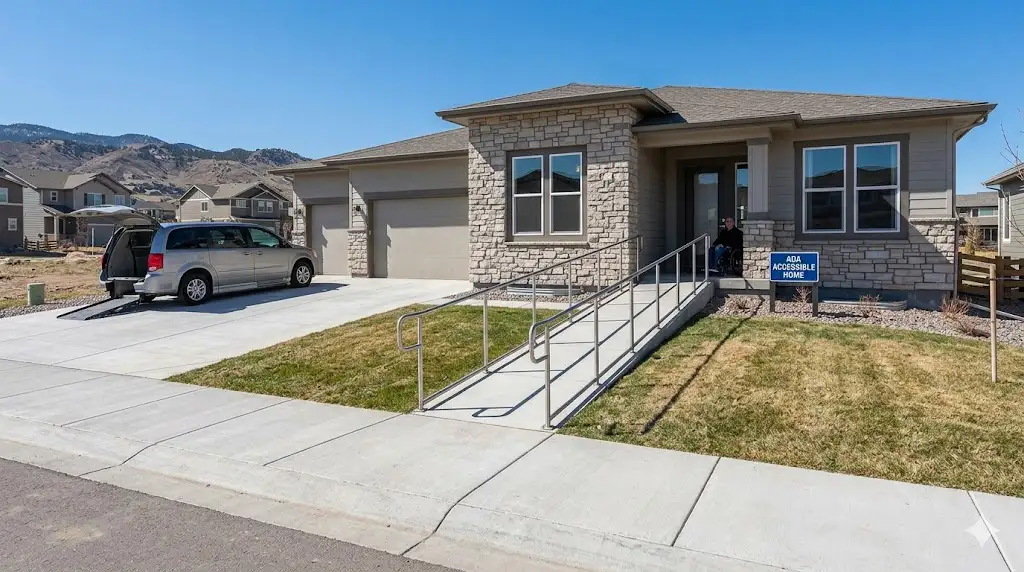
Searching for an ADA-accessible or wheelchair-adapted home in Douglas County comes with a frustrating reality: listing agents frequently check "accessible" in REcolorado simply because a home has a main-floor bedroom or a wide front porch, even if the primary bathroom door is only 28 inches wide or the garage entry has a steep 12-inch concrete step. Conversely, many single-story floor plans that are 90% ready for barrier-free living never get tagged with accessibility keywords in the MLS.
Because I work as a licensed Realtor, active residential builder, home rehab specialist, and engineer, we approach your search on two parallel tracks. First, we monitor live MLS inventory for properties that already feature zero-step entries, widened 36-inch doorways, curbless showers, or residential elevators. Second, we tour structurally adaptable single-story ranch homes in Highlands Ranch and calculate the exact scope, timeline, and budget required to custom-tailor the thresholds, primary bathroom, and kitchen before you move in.
Comparing Accessibility Potential Across Highlands Ranch Build Eras
Framing dimensions, hallway widths, and garage slab elevations evolved substantially between the 1980s and modern luxury construction. Knowing which subdivisions naturally accommodate wheelchairs, walkers, and zero-step living saves thousands of dollars in structural modifications:
| Construction Era & Tier | Best Neighborhoods to Target | Built-In Accessibility Advantages | Typical Builder Retrofit Scope |
|---|---|---|---|
| Luxury Custom & Semi-Custom Ranches (2005–Newer) | Backcountry, Firelight, Highwoods, and Highlands Ranch Golf Club offer expansive single-level and 1.5-story layouts. | Homes often include 36-inch doorways, 48-inch hallways, open kitchens, oversized 3-car garages, and stacked elevator closets. | Minimal framing changes needed; most buyers only add a low-slope garage threshold ramp and a curbless primary shower pan. |
| Low-Maintenance Patio Ranches & Active Adult (1998–2016) | Gleneagles Village, Tresana, Verona, and The Villages feature single-level patio and courtyard floor plans. | Flat driveways, 1-to-2-step garage entries, main-level laundry rooms, and wide great-room sightlines simplify daily mobility. | Common upgrades include removing narrow water-closet privacy doors, widening the primary bath entry, and installing grab-bar blocking. |
| Established Classic Single-Story Homes (1981–1997) | Northridge, Eastridge, Westridge, and Falcon Creek offer lower-cost single-story footprints on mature lots. | All bedrooms sit on one level over a full wood-joist basement that makes under-floor plumbing modifications easy. | Plan on widening 28-to-30-inch bedroom/bath doors to 36 inches, removing kitchen partition walls, and gutting the primary bath. |
Buyers seeking modern luxury with wide corridors and minimal structural remodeling frequently focus on single-story and patio enclaves in Backcountry or explore 55+ senior and age-targeted communities in Highlands Ranch, where snow removal and exterior maintenance are handled for you.
A Builder's Inspection Checklist for Ramps, Doorways & Roll-In Showers
When we walk a candidate home together in Highlands Ranch, I bring a laser measure and evaluate the structure through a residential builder's lens so you know the exact cost and feasibility of barrier-free modifications before submitting an offer:
- Garage Slab Drop & 1:12 Ramp Geometry: In Colorado, garage slabs are poured lower than the interior living floor to meet fire and building codes. If the vertical rise from the garage floor to the mudroom threshold is 8 inches, an ADA-standard 1:12 slope requires an 8-foot ramp run plus a 5-by-5-foot turning platform at the bottom and top. We measure the exact garage bay depth and width to verify whether a straight ramp, an L-shaped switchback ramp, or a compact vertical platform lift fits cleanly without blocking car doors.
- Widening 28-Inch & 30-Inch Doorways to 36 Inches: Power wheelchairs and wide manual chairs require at least 32 inches of clear opening (achieved with a 36-inch `3/0` door slab). When inspecting 1980s and 1990s homes, I check both sides of narrow hallway and bathroom door frames to verify whether load-bearing king studs, electrical switch boxes, or HVAC return ducts need to be relocated when installing a wider header.
- Recessing Floor Joists for Zero-Threshold Roll-In Showers: Unlike slab-on-grade homes in other states that require jackhammering concrete to lower a shower drain, Highlands Ranch single-family homes sit over wood floor joists in the basement. That allows us to sister and recess the subfloor framing beneath the primary shower so the tile floor slopes seamlessly into a linear trench drain with zero curb to step or roll over. Read our step-by-step construction guide on retrofitting Highlands Ranch bathrooms with roll-in showers.
Designing Accessible Kitchens, Electrical Controls & Residential Elevators
True independence at home extends beyond getting through the front door. Combining custom kitchen layout design with my background as a engineer allows us to plan high-function, high-resale accessibility upgrades that look like luxury architectural design rather than institutional modifications:
- Barrier-Free Kitchen Islands & Roll-Under Workstations: We design custom kitchen layouts with 48-to-60-inch perimeter aisle clearances around the island, 30-to-34-inch lowered counter prep zones with open knee clearance underneath, front-control induction cooktops (eliminating burn hazards when reaching across burners), side-swing wall ovens at chest height, and under-counter drawer microwaves and dishwashers.
- Electrical Load Panels, Switch Heights & Smart Automation: During a remodel, we can lower wall light switches and thermostats to 42–48 inches above the finished floor, raise receptacle outlets to 18 inches so you never have to bend to the baseboard, install motion-activated LED toe-kick night lighting along hallways and bathrooms, and wire dedicated 20-amp circuits for power-transfer ceiling tracks, bidets, or garage platform lifts.
- Multi-Level Access via Stacked-Closet Elevators & Walkout Basements: If you love a two-story home or want full access to a finished basement, we evaluate stacked 5-by-5-foot closets or corner stairwell geometry for hydraulic or through-floor pneumatic elevator retrofits, or target sloped lots where a paved exterior pathway connects the driveway to a zero-step walkout basement patio.
Frequently Asked Questions
What makes a home in Highlands Ranch truly wheelchair or ADA accessible?+
Which Highlands Ranch neighborhoods have floor plans best suited for accessibility?+
How much garage depth is required to install a wheelchair ramp in a Highlands Ranch home?+
Can a standard primary bathroom in Highlands Ranch be converted into a curbless roll-in shower?+
Can interior doorways in 1980s and 1990s Highlands Ranch homes be widened to 36 inches?+
Is it possible to install a residential elevator in a two-story or walkout ranch home?+
Do exterior accessibility ramps require HRCA architectural approval in Highlands Ranch?+
Are HRCA recreation centers and parks in Highlands Ranch wheelchair accessible?+

Highlands Ranch Realtor, residential builder, home rehab expert, and engineer sharing general construction knowledge, layout and remodeling ideas for basements, decks, landscaping, and kitchens, and helping clients know what questions to ask independent licensed inspectors across Douglas County.
Want a builder and engineer to evaluate a home's wheelchair accessibility or retrofit costs before you buy?
Read Saber's Builder & Engineer Bio or reach out directly for a private tour and barrier-free assessment.