

Kitchen Remodel Scope & Custom Layout Design in Highlands Ranch
Remodeling a kitchen in Highlands Ranch varies dramatically depending on when the home was built. While 2000s luxury villages and brand-new builds already feature open-concept great rooms, 200-amp electrical panels, and large center islands, transforming a compartmentalized 1980s or 1990s kitchen often involves engineered structural beams, HVAC and plumbing stack relocations, dedicated 240V appliance circuits, and continuous main-level hardwood lacing.
Skip the endless search filters. Tap the microphone icon inside our AI Concierge—or type your command—to find homes by price, square footage, neighborhood, walkout basement, greenbelt lot, or school feeder, plus get instant builder and HOA answers.
What Really Happens Behind the Drywall When Opening Up a Vintage Kitchen
Television renovation shows often make knocking down a kitchen wall look like a thirty-minute sledgehammer exercise. When advising families through our Buying Older Homes in Highlands Ranch hub, I love sharing a residential builder and engineer's perspective on how floor plans actually carry weight—and how to spot the difference between a straightforward cosmetic refresh and a full structural reconfiguration before you buy.
In established 1980s and 1990s two-story neighborhoods such as Northridge, Eastridge, and early Westridge or Southridge filings, builders typically separated the kitchen from the formal dining room or family room with a central interior stud wall and a L-shaped or U-shaped peninsula. In two-story framing, that center partition frequently carries the overlapping ends of the second-floor bedroom joists above. Removing it requires stamped plans from a licensed structural engineer, a Douglas County building permit, temporary shoring walls, and hoisting an engineered laminated veneer lumber (`LVL`) header or steel I-beam into place—along with ensuring the point-load posts at each end transfer cleanly down through the subfloor to concrete footings or basement steel columns below.
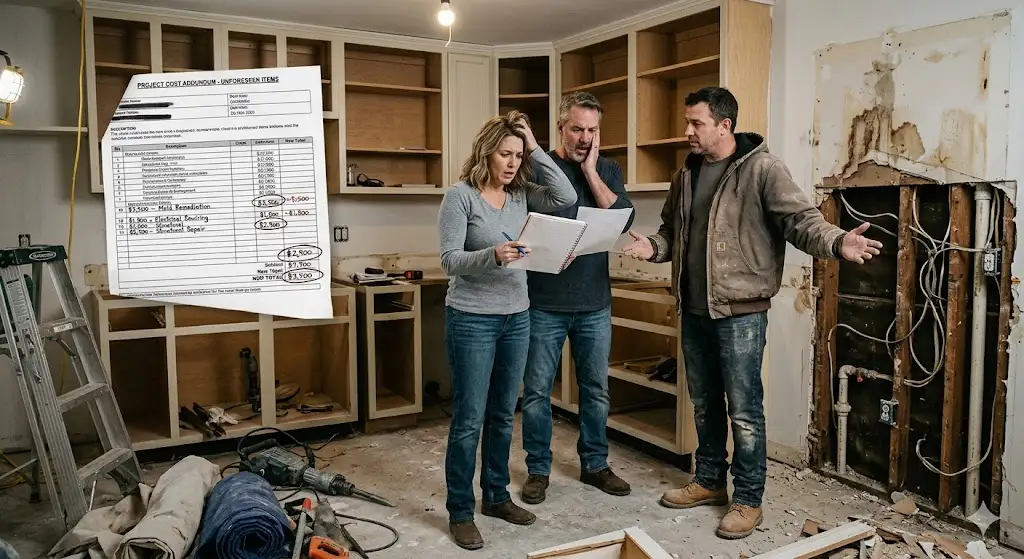
Even when a partition wall is only partially load-bearing, two-story 1990s walls routinely conceal vertical mechanical chases: second-floor bathroom drain and vent stacks, rectangular sheet-metal cold-air returns, furnace flues, and multi-gang lighting circuits. By contrast, homes built in the 2000s and 2010s across Backcountry, Tresana, and Firelight—as well as brand-new luxury construction—were engineered from the ground up with wide-span floor trusses and open great-room sightlines, meaning buyers in those eras rarely need to move structural walls to enjoy an open kitchen.
Electrical Load Capacity, Island Plumbing & Range Hood Makeup Air
Cabinetry and stone slabs are the visible stars of a kitchen remodel, but the hidden mechanical, electrical, and plumbing (`MEP`) rough-ins determine how well the space functions every day. Here are the key infrastructure items I help clients think through alongside their licensed contractors:
- Dedicated 120V/240V Appliance Circuits & Panel Capacity: A 1990s kitchen was typically wired for a single slide-in range, a dishwasher/disposal circuit, and two small-appliance countertop loops. Upgrading to an induction cooktop, double convection wall ovens, a built-in microwave drawer, a warming drawer, and an under-counter beverage center requires a licensed electrician to pull multiple dedicated circuits with modern `GFCI`/`AFCI` breakers—and occasionally pair the project with an electrical panel upgrade as detailed in our Highlands Ranch electrical rehab guide.
- Relocating Sinks & Dishwashers to a Center Island: Moving a perimeter window sink into a new freestanding center island requires routing hot and cold supply lines, a properly sloped drain line, and an island loop vent or air-admittance valve (`AAV`) per code. If the basement ceiling directly underneath the kitchen is unfinished, plumbers have straightforward joist access; if the basement is already finished with drywall ceilings, budget for basement ceiling access and restoration.
- Soffit Removal & 42-Inch Full-Height Cabinetry: Many 1980s and 1990s kitchens feature drywall furr-down soffits boxes above 30-inch oak or maple cabinets. Before assuming those soffits are empty decorative boxes, remember they frequently hide plumbing drain elbows from an upstairs bathroom or kitchen exhaust ductwork that must be tucked up into the ceiling joist bays when installing tall 42-inch cabinets.
- Exterior Range Hood Venting & Makeup Air Systems: Replacing a recirculating microwave hood with a commercial-style gas range and a quiet, high-capacity exhaust hood (over 400 `CFM`) requires running rigid smooth-walled ductwork to the exterior and, under Douglas County mechanical codes, installing an interlocked makeup-air damper so the hood does not depressurize the house or back-draft water heaters and fireplaces.
Highlands Ranch Kitchen Architecture & Remodel Scope by Build Era
The table below compares original kitchen construction across all three eras of Highlands Ranch homes so buyers can align their home search with their remodeling appetite.
| Highlands Ranch Build Era | Original Kitchen Footprint & Infrastructure | Typical Remodel Scope & Design Focus |
|---|---|---|
| Established 1980s & 1990s Filings Northridge, Eastridge, Early Westridge/Southridge |
Compartmentalized dining walls, wrap-around peninsulas, drywall soffits over 30-inch cabinets, oak flooring laid up to cabinet toe-kicks, and 100A–150A electrical panels. | Ideal for buyers wanting to custom-build an open layout via engineered LVL headers, soffit removal, dedicated 240V circuits, center island conversion, and main-level hardwood lacing. |
| 2000s & 2010s Luxury & Custom Villages Backcountry, Tresana, Firelight, Highwoods |
Open-concept great-room sightlines, 42-inch cabinets, walk-in pantries, gas cooktops, double ovens, and 200-amp electrical service already in place. | Structural walls rarely need moving; high-ROI updates focus on leveling two-tier bar islands into single-level quartz slabs, updating backsplashes, and adding under-cabinet LED lighting. |
| Brand-New Construction & Newer Luxury Builds Modern Custom & Semi-Custom Filings |
Oversized single-slab islands, butler's or scullery prep pantries, exterior-vented hoods with makeup air, induction-ready 240V circuits, and multi-slide patio doors. | Move-in-ready culinary architecture that serves as the design benchmark when we help clients plan custom remodels in older neighborhoods. |
The Hardwood Flooring Domino Effect—Plus Smart Kitchen Layout Ideas
One of the most overlooked budget items when changing a kitchen footprint is what sits underneath the original base cabinets. In the 1980s and 1990s, builders almost always set the kitchen cabinets directly onto the bare `OSB` subfloor first and then installed site-finished 2.25-inch red oak hardwood planks up to the cabinet toe-kicks. The moment you demolish an angled peninsula, remove a built-in work desk, or rotate an island, you expose raw subfloor footprints across the room.
To make the floor continuous, a hardwood specialist must "lace in" (tooth-in) new raw oak boards into the existing pattern and then drum-sand, stain, and seal the entire contiguous main floor so the color and sheen match from the front entry to the family room. Knowing this ahead of time helps you budget accurately—or decide to keep your perimeter cabinet footprint intact while redesigning the island and upper cabinetry.
When I share custom kitchen layout ideas with clients during property tours—alongside ideas for custom basements, decks, and backyard landscaping—we look for practical ways to maximize storage, natural light, and resale appeal without unnecessary structural demolition:
- Convert Two-Tier Bar Tops to a Single Counter-Height Slab: Many 1990s and 2000s islands have an elevated 42-inch bar ledge that visually cuts the room in half. Lowering that pony wall to a uniform 36-inch counter height creates an expansive single-plane quartz or quartzite work surface without moving a single plumbing pipe.
- Replace Unused 1990s Telephone Desks with a Beverage & Coffee Station: Nearly every 1990s Highlands Ranch kitchen has a low built-in mail desk near the pantry. Replacing that desk with full-depth pantry pull-outs, a quartz coffee bar, and an under-counter beverage cooler uses the existing wall footprint and electrical box cleanly.
- Prioritize Deep Lower Drawers & Work-Triangle Clearances: Designing base cabinets with full-extension soft-close drawers (rather than dark lower doors) and maintaining 42 to 48 inches of walkway clearance around the island allows two cooks to pass open dishwasher and oven doors effortlessly.
Frequently Asked Questions
What makes opening a kitchen wall in a 1980s or 1990s two-story home complex?+
What hidden mechanical chases often run inside older kitchen partition walls?+
How do kitchen remodel scopes differ across Highlands Ranch's three build eras?+
Why do modern luxury kitchen appliances require electrical panel and circuit upgrades?+
What is the hardwood flooring domino effect when changing a kitchen footprint?+
Why does high-CFM kitchen range hood ventilation require careful planning in Colorado?+

Highlands Ranch Realtor, residential builder, home rehab expert, and engineer sharing general construction knowledge, layout and remodeling ideas for basements, decks, landscaping, and kitchens, and helping clients know what questions to ask independent licensed inspectors across Douglas County.
Want a builder and engineer's perspective when buying, selling, or planning updates in Highlands Ranch?
Read Saber's Builder & Engineer Bio or reach out directly for a personal advisory conversation.