

Homes with Walk-Out Basements — Live Market Pulse & Sold Scorecard
Anchored on Highlands Ranch ZIP codes 80126, 80129 & 80130 to automatically capture all listings entered under both "Highlands Ranch" and "Littleton" postal cities.
• Single-Family Detached: 78 Active · 86 Sold · Median Sold: $700,000 (Avg: $795,187 · $293/SqFt)
• Condos & Townhomes: 19 Active · 14 Sold · Median Sold: $521,867 (Avg: $526,830 · $323/SqFt)
- 864 English Sparrow Trail — $625,000 · 3 Bed · 4 Bath · 2,500 SqFt · Highlands Ranch (Listing courtesy of Serhant Colorado LLC via REcolorado)
- 10636 Wildhurst Circle — $699,000 · 0 Bed · 0 Bath · 2,647 SqFt · Highlands Ranch Firelight (Listing courtesy of Mainstay Brokerage LLC via REcolorado)
- 1384 Shadow Mountain Drive — $950,000 · 6 Bed · 4 Bath · 3,641 SqFt · Highlands Ranch (Listing courtesy of KOIS REAL ESTATE via REcolorado)
- 10828 Cedar Brook Street — $745,000 · 3 Bed · 3 Bath · 2,562 SqFt · Highlands Ranch (Listing courtesy of Redfin Corporation via REcolorado)
- 9647 Cove Creek Drive — $619,000 · 3 Bed · 3 Bath · 1,817 SqFt · Westridge (Listing courtesy of Steven E Crozier, Independent Broker via REcolorado)
- 4244 Lark Sparrow Street — $630,000 · 3 Bed · 4 Bath · 2,438 SqFt · Highlands Ranch (Listing courtesy of One Stop Realty, LLC via REcolorado)
Market statistics calculated from live REcolorado IDX feed (excluding rentals and non-arm's-length entries). Have questions about a specific street, lot orientation, or remodeling layout (basements, decks, landscaping, kitchens)? Call/text Saber Amine (Owner & Designated Broker, Homes and People, Colorado Real Estate License #ER40029599) at 720-842-1600 or Contact Saber.




Skip the endless search filters. Tap the microphone icon inside our AI Concierge—or type your command—to find walk-out basement homes by price, neighborhood, greenbelt backing, or mountain views, plus get instant basement finishing and structural grading answers.
Where to Find Walk-Out Basements Across All Three Highlands Ranch Build Eras
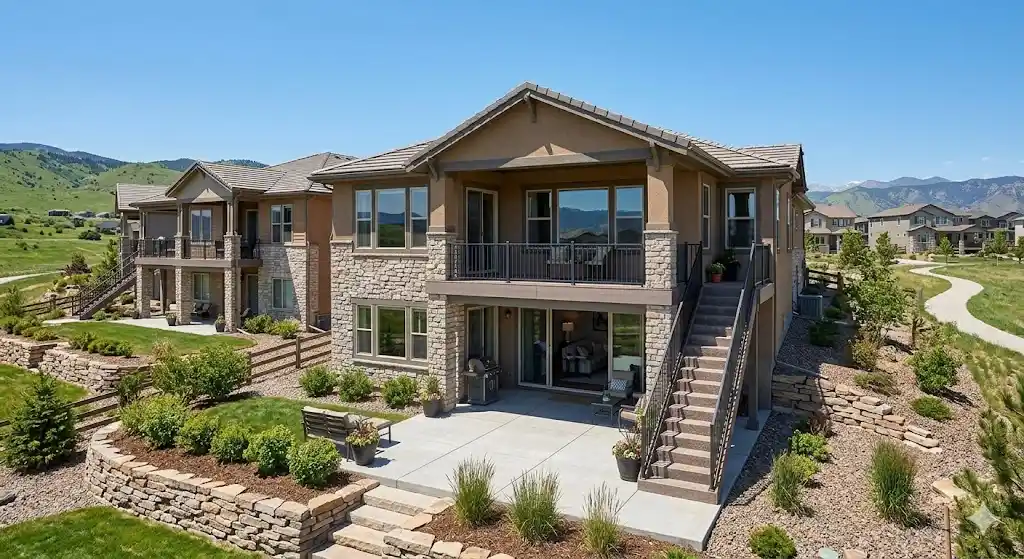
A true walk-out basement cannot simply be drawn onto any blueprint; it requires a building pad with roughly eight to eleven feet of natural elevation drop from the front curb to the rear foundation line. Because Highlands Ranch rises from the northern High Line Canal plains toward the southern bluffs bordering the 8,200-acre Backcountry Wilderness Area, walk-out availability shifts dramatically depending on the subdivision's topography and construction decade.
In newer custom and semi-custom enclaves within Backcountry, builders engineered steep ridge-line lots specifically for expansive lower-level indoor-outdoor living, pairing 9-foot to 10-foot foundation pours with factory-installed multi-slide glass doors and covered lower loggias. Across 2000s and 2010s move-up and luxury neighborhoods—such as Firelight, The Hearth, Indigo Hill, Shadow Canyon, Tresana, and Timberline Ridge—walk-out homes trace the edges of winding open-space ravines and HRCA trail corridors. Meanwhile, in established 1980s and 1990s villages like Northridge, Eastridge, Westridge, Falcon Hills, and Mansion Hills, walk-out floor plans are prized rarities tucked onto bluff-top cul-de-sacs, golf course slopes, and deep greenbelt gulches.
| Highlands Ranch Build Era | Primary Walk-Out Subdivisions & Terrain | Foundation Specs & Ceiling Heights | Builder & Engineer Inspection Focus |
|---|---|---|---|
| Newer Custom & Late-Phase Luxury (Late 2010s–2020s) | Upper Backcountry custom estates and premier ridge-top lots backing directly to the Backcountry Wilderness Area. | Engineered caisson foundations feature 9-foot to 10-foot lower-level ceilings, structural steel beams, and wide multi-panel glass doors. | Verify multi-zone HVAC balancing across large glass exposures, inspect boulder retaining wall drainage, and review custom wet bar rough-ins. |
| 2000s & 2010s Luxury & Move-Up Communities | Firelight, Backcountry, Tresana, The Hearth, Indigo Hill, Shadow Canyon, Kentley Hills, and Timberline Ridge ravine lots. | Most properties offer 9-foot basement pours with engineered I-joist floor systems, daylight picture windows, and 6-foot to 8-foot patio doors. | Evaluate side-yard drainage swales, check structural floating wall gaps on post-closing basement finishes, and inspect elevated composite decks. |
| Established 1980s & 1990s Villages | Northridge, Eastridge, Westridge, Southridge, Falcon Hills, Highwoods, and Mansion Hills greenbelt and golf course lots. | Standard 8-foot foundation pours (8.5-foot to 9-foot in custom enclaves) often include dropped HVAC soffits and original sliding glass doors. | Inspect 30-year-old timber retaining walls for rot, check lower slabs for hydrostatic heave, and evaluate 150-amp electrical panels for remodel loads. |
A Builder's Field Inspection: Sloped Lot Grading, Hydrostatic Pressure & Retaining Walls
When buyers walk down into a sunlit walk-out basement, their eyes naturally go straight to the mountain view, the backyard patio, or the finished rec room. As an active residential builder and home rehab specialist, my eyes go immediately to the exterior side-yard slopes, the concrete foundation corners, and the retaining walls holding the hill in place. Every walk-out lot sits on a hydraulic gradient: during heavy spring snowmelt and summer cloudbursts, roof runoff and uphill groundwater travel down the side yards toward the lower backyard.
As detailed in our foundation health and expansive clay soils guide, Douglas County sits atop moisture-sensitive bentonite clay. If side-yard drainage swales have flattened out under decades of decorative rock, or if downspouts discharge next to the stepped foundation wall, water saturates the clay soil on the uphill side while eroding the soil beneath the exposed lower walk-out patio slab. Before you submit an offer on a walk-out home, we help you know what to ask your licensed inspector regarding four critical exterior systems:
- Stepped Foundation Wall Transitions: Walk-out foundations step down from standard subterranean frost walls at the front of the house to full-height exposed walls at the rear. Diagonal cracks at those step transitions or horizontal bowing along the side foundation walls indicate lateral soil pressure that must be evaluated before closing.
- Retaining Wall Material & Weep Drainage: Many 1980s and 1990s walk-out lots used pressure-treated railroad ties or stacked landscape timbers to hold back the side-yard grade. After 25 to 35 years, timber walls rot and lean inward; replacing a tall structural retaining wall over four feet high requires engineered geogrid tie-backs, crushed gravel backfill, perforated drain tile, and a Douglas County building permit.
- Walk-Out Patio Slab Undermining & Negative Pitch: At the bottom of the slope, the exterior concrete patio must pitch slightly away from the basement threshold while channeling water around the patio perimeter. If soil washout creates voids under the outer edge of the patio, or if clay swell tilts the slab back toward the sliding glass door track, water will seep directly under the bottom sill plate.
- Sump Pit, Perimeter Drain & Radon System Operation: Even on a sloped walk-out lot, subsurface water collects along the uphill footing. We verify that the perimeter drain discharges cleanly to daylight or an active sump pit and check how any radon mitigation piping is routed so it does not obstruct future basement layout changes.
Custom Walk-Out Basement, Under-Deck Patio & Wet Bar Layout Design
Because a walk-out basement receives full-height natural daylight and opens directly to the backyard, it functions like a second main floor rather than a subterranean cellar. Designing custom basements, elevated decks, landscaping transitions, and lower-level kitchen or wet bar layouts is where a builder's eye creates the highest lifestyle and resale return. Whether you are purchasing a home with an unfinished walk-out lower level or reimagining a dated 1990s or 2000s finish, we help you evaluate architectural feasibility right inside the showing:
- Widening Exterior Doors for Multi-Slide Glass Walls: Upgrading a builder-grade 6-foot sliding glass door to a 12-foot or 16-foot multi-panel stacking or folding glass wall completely transforms a walk-out family room. Because the rear walk-out wall supports the main level, second floor, and roof loads above, we calculate whether the wall is full-height poured concrete or a cripple-framed walk-out wall over a knee wall, and design the structural steel I-beam or laminated veneer lumber (LVL) header needed to carry the load safely.
- Designing Wet Bars, Second Kitchens & Guest Suites: Walk-out basements are ideal for multi-generational suites and entertaining zones, but layout design must work around existing main sewer drain lines, steel support columns, and HVAC trunk lines. In 1980s and 1990s homes with 8-foot foundation walls, we design custom perimeter soffits and recessed lighting grids that preserve maximum ceiling height while positioning wet bars near existing plumbing stacks to avoid unnecessary slab trenching.
- Elevated Main-Level Decks & Dry Under-Deck Ceilings: Almost every walk-out home has a high main-level deck sitting nine to twelve feet above the lower concrete patio. As covered in our elevated deck safety and structural ledger inspection guide, tall walk-out decks require deep concrete caissons, steel post-to-beam hardware, and flashed ledger attachments. Adding an integrated under-deck drainage ceiling beneath the upper deck joists channels rain and snowmelt into perimeter gutters, turning the walk-out patio below into a dry, shaded outdoor living room wired for recessed lighting, ceiling heaters, and outdoor audio.
- Landscaping & Indoor-Outdoor Grade Transitions: A great walk-out design connects the lower patio to the rest of the yard. We evaluate how wide stone stairways, terraced planter beds, and privacy screening along HRCA greenbelt wrought-iron fences can be integrated without blocking the lot's engineered drainage path.
Engineer's Audit: Sub-Panels, HVAC Zoning & Douglas County Permitting
Walk-out basements place unique demands on a home's electrical and mechanical infrastructure. Unlike a standard basement surrounded on all four sides by 55-degree earth, a walk-out basement has an entire exterior wall of glass and framing exposed to sub-zero winter nights and intense high-altitude afternoon sun. Combined with the electrical load of modern lower-level amenities, an engineering audit prevents expensive surprises after closing:
- Electrical Panel Capacity & Dedicated Circuit Planning: When homeowners finish or remodel a walk-out basement, they frequently add an under-counter beverage center, microwave drawer, dishwasher, espresso station, home theater rack, bathroom radiant floor heat, steam shower, and a 50-amp or 60-amp 240-volt GFCI spa disconnect on the walk-out patio outside. As a engineer, I help you know what to ask your licensed inspector regarding the main service panel rating (150-amp in many 1980s and 1990s homes versus 200-amp to 400-amp in newer builds), check bus-bar condition, and verify whether a dedicated basement sub-panel is required to meet current National Electrical Code AFCI and GFCI standards.
- HVAC Return-Air Placement & Thermal Comfort: Poorly finished walk-out basements often feel chilly in January because the builder or previous contractor cut a couple of ceiling supply vents into the main trunk line without installing floor-level cold-air returns. Because cold air pools along the lower concrete slab in front of the sliding glass doors, proper walk-out mechanical design pairs Low-E insulated glass and closed-cell rim-joist insulation with low-wall return ducts and motorized zone dampers.
- Verifying Douglas County Permits & Structural Float Gaps: During due diligence, we check Douglas County Building Division permit records against the home's finished basement square footage. An unpermitted DIY basement finish often conceals rigid walls nailed tightly to the concrete slab (omitting the mandatory 1.5-inch to 2-inch structural float gap required over expansive soils), buried electrical junction boxes, or unvented bathroom plumbing traps. Identifying those items upfront gives you clear leverage during inspection negotiations and ensures your investment is safe and code-compliant.
Frequently Asked Questions: Walk-Out Basements in Highlands Ranch
Which neighborhoods in Highlands Ranch have the highest concentration of walk-out basements?+
What is the difference between a true walk-out basement and a garden-level or look-out basement?+
What are the biggest structural risks of buying a walk-out basement home on a sloped lot?+
Can I replace a standard sliding patio door with a wide multi-panel folding or stacking glass wall?+
Does a finished walk-out basement count toward total square footage on a Colorado appraisal?+
Why do Douglas County walk-out basements require floating interior walls?+
How should I help you know what to ask your licensed inspector regarding the elevated main-level deck above a walk-out basement patio?+
What electrical capacity is needed when adding a basement wet bar, second kitchen, or patio hot tub?+
Do I need both a Douglas County building permit and HRCA architectural approval to remodel a walk-out basement?+
How do you keep a walk-out basement warm in the winter when it has large glass doors and windows?+

Highlands Ranch Realtor, residential builder, home rehab expert, and engineer sharing general construction knowledge, layout and remodeling ideas for basements, decks, landscaping, and kitchens, and helping clients know what questions to ask independent licensed inspectors across Douglas County.
Want a builder and engineer's eye on a sloped walk-out lot, retaining wall, or custom basement remodel?
Read Saber's Builder & Engineer Bio or reach out directly for a private property and structural evaluation.