

Radon Testing & Mitigation Systems in Highlands Ranch
When I walk buyers and sellers through inspection contingencies across Highlands Ranch, radon gas is the single most common item that shows up on the objection notice. Because all of Douglas County sits atop uranium-bearing Front Range granite and shale, nearly half of unmitigated local homes test at or above the federal action threshold. The good news is that an elevated reading is one of the easiest, most predictable engineering fixes in residential real estate when you know how sub-slab suction systems, crawlspace membranes, and seller concessions work together.
Why Douglas County Sits in EPA Radon Zone 1 (& What Colorado Law Requires)
Out-of-state buyers moving to Highlands Ranch from coastal or southern states are often surprised when their home inspector sets up an electronic radon monitor on day one. Every single county along the Colorado Front Range is classified by the federal government as Zone 1, the highest potential category for indoor radon gas. Because our foothills and Palmer Divide ridges were formed from decomposing granite and uranium-rich shale, odorless radon gas naturally percolates upward through the soil beneath every neighborhood in town.
When a house warms up during a chilly Colorado evening, rising heated air inside the structure creates a gentle vacuum known to builders and engineers as the thermal stack effect. That indoor pressure difference draws soil gas through microscopic concrete slab joints, sump crocks, and utility penetrations at the lowest level of the home. One house on a cul-de-sac in Northridge or Eastridge can test comfortably low while the neighbor right next door reads three times the federal action threshold simply because of a slightly different gravel vein or slab crack pattern beneath the basement floor.
- EPA 4.0 pCi/L Action Threshold vs. WHO 2.7 pCi/L Target: According to Colorado Department of Public Health and Environment surveillance data, roughly 46.4% of unmitigated Douglas County homes test at or above the 4.0 picocuries per liter federal action level, and many buyers also watch the stricter 2.7 pCi/L World Health Organization reference benchmark.
- Colorado Senate Bill 23-206 Real Estate Disclosures (C.R.S. § 38-35.7-112): Colorado law requires every residential purchase contract to carry a bold statutory radon warning, mandates delivery of the official state radon brochure, and obligates sellers to disclose all known prior test results and any active or passive mitigation equipment on the property.
- Engineering Perspective vs. Licensed Radon Specialists: When we walk through a basement together, I am not acting as a state-licensed radon tester or replacing your independent home inspector. My role as an engineer, residential builder, and Realtor is sharing general construction knowledge so you can spot how a basement slab is built and ask your licensed specialist the right questions.
How a 48-Hour Real Estate Radon Test Works (& Why DORA Licensure Matters)
During a Colorado home purchase, timing and test validity matter just as much as the radon number itself. Under state law enacted through the Colorado Department of Regulatory Agencies, anyone performing radon testing or mitigation for compensation must hold an active state license alongside national certification. If a buyer tries to use a mail-in hardware store charcoal kit during an inspection window, a savvy listing agent can push back on the result because no one verified closed-building conditions or hourly tamper logs.
A licensed measurement professional deploys a calibrated electronic Continuous Radon Monitor for at least forty-eight hours in the lowest livable level of the home. Note that in Colorado real estate transactions, an unfinished basement counts as a testable lowest livable level because future owners can use it for a home gym, workshop, or finished living space without structural excavation. The electronic monitor records hourly radon concentrations alongside barometric pressure, temperature, and motion sensors so both sides of the contract can trust the final printout.
- 12-Hour Pre-Test Closed-Building Rule: Exterior windows and patio doors must remain closed for at least 12 hours before the monitor starts and throughout the entire 48-hour test, with only normal momentary entry and exit through exterior doors.
- Exact ANSI/AARST Monitor Placement Geometry: The testing device must sit at least 20 inches off the floor, at least 12 inches from exterior foundation walls, and at least 36 inches away from windows, doors, or direct furnace supply registers—never inside a bathroom, closet, laundry room, or dirt crawlspace.
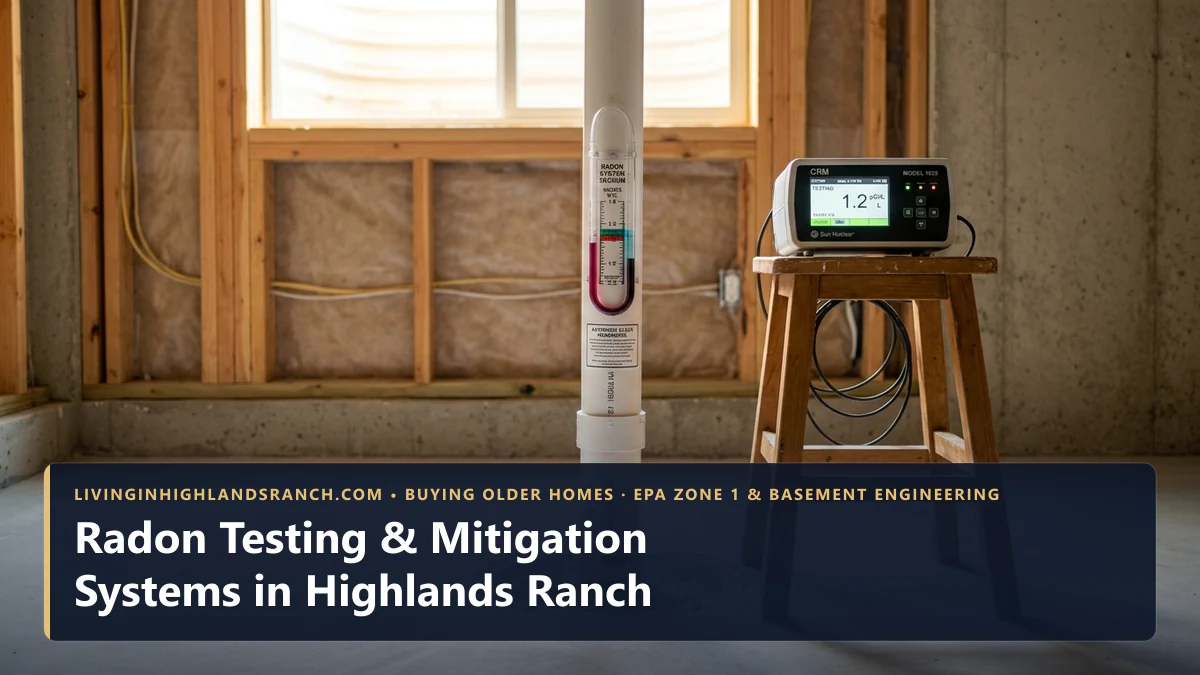
- Checking Existing U-Tube Manometers During Showings: When a home already has an active mitigation pipe in the utility room, we always check the curved liquid gauge on our very first walkthrough to confirm the oil columns show an active vacuum differential between 0.5 and 1.8 inches of water column rather than sitting flat at zero.
How Radon Mitigation Systems Differ Across All 3 Highlands Ranch Build Eras
Not every basement in Highlands Ranch is engineered the same way, and the decade a home was built dictates both how soil gas enters the structure and how a mitigation contractor routes the exhaust pipe. In our original nineteen-eighties and nineteen-nineties neighborhoods like Northridge, Eastridge, Westridge, and Southridge, builders poured basement slabs over expansive clay without passive vent pipes. Over time, minor seasonal slab movement along perimeter cove joints and open plastic sump pits creates direct pathways for soil gas, which you can explore further in our companion guide to foundation health and expansive bentonite soils.
Move-up homes built during the two-thousands and twenty-tens in neighborhoods like Firelight, Highwoods, Tresana, and earlier filings of Backcountry frequently introduce a second wrinkle: split foundations that pair a basement with an adjacent concrete or gravel crawlspace beneath a family room cantilever or front porch. If a contractor only depressurizes the concrete slab and ignores the adjacent crawlspace, soil gas from the unsealed crawlspace will still get pulled into the furnace return. Finally, newer luxury builds from twenty-fifteen forward usually come with a factory passive radon vent pipe running through the roof, but because tight modern insulation traps negative indoor pressure in winter, those passive pipes often still need an inline attic fan to pull levels down below two picocuries per liter.
| Build Era & Key Neighborhoods | Typical Foundation & Soil-Gas Entry | Recommended DORA Mitigation Setup | 2026 Installed Cost & 90-Day Concession Rate |
|---|---|---|---|
| 1981–1999 Established Era (Northridge, Eastridge, Westridge, Southridge) | Poured concrete slabs without passive rough-in stacks, open or perforated sump pits, and perimeter floor-to-wall cove joints over expansive clay. | Single-zone Active Soil Depressurization (ASD) coring into the slab or sealing the sump crock with an airtight polycarbonate lid, routed through the garage attic or painted to match exterior siding per HRCA rules. | $1,200 to $1,950 installed; 70.5% of 1981–1999 closed SFR sellers paid concessions averaging $11,097 ($702,500 median price across 166 sales). |
| 2000–2014 Move-Up & Luxury Era (Firelight, Highwoods, The Hearth, Tresana, Backcountry) | Larger basement footprints (often walk-outs) combined with adjacent dirt, gravel, or rat-slab crawlspaces beneath cantilevers and covered entries. | Dual-zone ASD + Sub-Membrane Depressurization (SMD) tying the basement suction pipe into a sealed, polyurethane-caulked 6-mil to 12-mil reinforced polyethylene crawlspace vapor barrier. | $1,850 to $3,200 installed; 61.3% of 2000–2014 closed SFR sellers paid concessions averaging $11,248 ($720,000 median price across 62 sales). |
| 2015–Present Newer Luxury & New Builds (Backcountry Later Filings & Custom Infill) | Gravel aggregate bed beneath the slab with a builder-installed passive Radon-Resistant New Construction (RRNC) PVC vent pipe running through the roof. | Passive-to-active conversion: mounting a continuous-duty inline radon fan on the existing PVC stack in the attic (using the pre-wired junction box), sealing the sump lid, and adding a basement U-tube manometer. | $600 to $1,100 fan activation; 30.0% of 2015+ closed SFR sellers paid concessions averaging $13,667 ($1,224,975 median price across 20 sales). |
| Existing System Fan Swap or Sump Reseal (All Neighborhoods & Build Eras) | Previously mitigated homes where the inline fan bearings hum loudly or the U-tube manometer reads 0.0 inches after 8 to 12 years of continuous service. | Direct inline fan replacement with rubber Fernco couplings, fresh silicone gasket seal on the removable sump inspection cover, and a post-installation 48-hour verification test. | $350 to $650 for fan swap ($150 to $225 for a certified 48-hour CRM inspection test; ~$25 to $55/year in continuous Xcel Energy electricity). |
Negotiating Radon Credits & Protecting Your Finished Basement Value
A high radon reading during your inspection objection period should never derail a great house purchase or panic a seller. In our verified ninety-day REcolorado market audit across Highlands Ranch detached homes, nearly two out of three sellers paid closing cost concessions, and a standard radon system takes up less than a fifth of the typical credit package. That leaves plenty of room to structure a clean seller credit that covers both your radon mitigation invoice and a seller-paid 2-1 mortgage rate buydown without delaying closing day.
From a residential builder perspective, radon testing also plays a direct role in how we protect the spread between unfinished total structure square footage and finished basement living space. Before you frame floating basement walls or hang drywall—which we cover step by step in our Highlands Ranch basement finishing and remodeling guide—you want your radon suction pipe routed cleanly through an interior wall chase or garage attic into the roof rather than bolted onto the outside siding where it requires HRCA architectural approval and exterior painting.
Whether you are browsing Highlands Ranch homes for sale or preparing an older property in Northridge or Eastridge for the market, we pair every inspection negotiation with transparent transaction math. Keep in mind that in Colorado, real estate brokerage fees are not set by law and are individually negotiable outside the MLS, and REcolorado MLS rules strictly prohibit displaying or offering broker compensation in any MLS field.
| Sub-Area / Basement Cohort (Detached SFR) | 90-Day Closed Sales & Median Price | Seller Concession Frequency & Avg Credit | 3-Benchmark $/SqFt (Above / Fin / Total) & Negotiation Strategy |
|---|---|---|---|
| All Highlands Ranch Detached SFR (Excl. Province Center) | 248 closed sales (93 failed = 72.7% success); $715,000 median closed price in 27 median True CDOM. | 64.9% of sellers paid concessions averaging $11,228 when given. | $349 Above-Grade / $286 Finished / $244 Total Structure SqFt; a $1,650 radon credit uses just 14.7% of the average seller credit. |
| Northridge & Eastridge SFR (1980s–1990s Core) | Northridge: 38 sold at $665,000 median (32 CDOM). Eastridge: 53 sold at $715,000 median (22 CDOM). | Northridge: 78.9% paid $13,486 avg. Eastridge: 60.4% paid $10,188 avg. | Northridge: $354 / $292 / $244. Eastridge: $332 / $279 / $237. Highest frequency of open sump pits needing sealed polycarbonate lids. |
| Westridge & Southridge SFR (1990s–2000s Blend) | Westridge: 66 sold at $700,000 median (24 CDOM). Southridge: 91 sold at $769,000 median (28 CDOM). | Westridge: 68.2% paid $8,935 avg. Southridge: 59.3% paid $12,502 avg. | Westridge: $364 / $286 / $254. Southridge: $348 / $294 / $243. Always inspect split-level crawlspaces for sealed SMD vapor barriers. |
| Walk-Out Basement & 1-Story Ranch Homes | Walk-Out: 56 sold at $882,500 median. 1-Story Ranch: 25 sold at $915,000 median (6 CDOM; 72.0% cash). | Walk-Out: 55.4% paid $13,146 avg credit. | Walk-Out: $346 / $256 / $230. Ranch: $494 / $358 / $289. Ranch floor plans have the widest slab-to-volume contact with the soil. |
Frequently Asked Questions
What does Colorado Senate Bill 23-206 require sellers to disclose about radon?
Why do newer Highlands Ranch homes with passive radon pipes still test above 4.0 pCi/L?
How do you read the U-tube manometer gauge on a basement radon pipe?

Highlands Ranch Realtor, residential builder, home rehab expert, and engineer who shares general construction knowledge, layout and remodeling ideas for basements, decks, landscaping, and kitchens, and helps clients know what questions to ask independent licensed inspectors.
Planning to buy or sell a home in Highlands Ranch or Douglas County? Put a full-time Realtor® and Master Negotiator with a Builder & Engineer’s eye on your side.
Read Saber’s Realtor, Builder & Engineer Bio or reach out directly for a personal advisory conversation.