


Skip the endless search filters. Tap the microphone icon inside our AI Concierge—or type your command—to find homes by price, square footage, neighborhood, walkout basement, greenbelt lot, or school feeder, plus compare water districts, HRCA amenities, and Metro District taxes.
Scale Across Quebec Street & The Public High School Feeder Reality
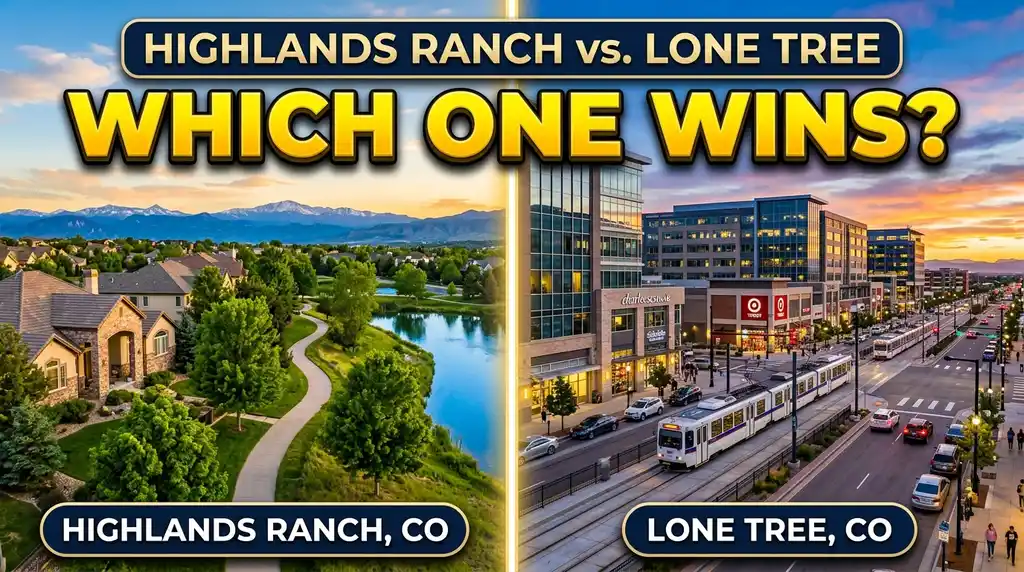
When relocating buyers look at northern Douglas County on a map, Highlands Ranch and Lone Tree appear to blend seamlessly together across Quebec Street. Once you look under the hood at land mass, population, and school zoning, however, the two communities operate on completely different scales.
Highlands Ranch is a massive, unincorporated master-planned community spanning 24 square miles (22,000 acres) with roughly 105,000 residents. Municipal services, 26 neighborhood parks, and more than 70 miles of paved trails are managed by the Highlands Ranch Metro District, while community standards and private recreation centers are governed by the Highlands Ranch Community Association (HRCA). Lone Tree, by contrast, is an incorporated boutique municipality of just 9.8 square miles and roughly 14,500 residents.
That difference in population scale creates one of the biggest surprises for families shopping in the Douglas County School District (DCSD). Highlands Ranch has four dedicated comprehensive public high schools located right inside the community: Highlands Ranch High School, Mountain Vista High School, ThunderRidge High School, and Rock Canyon High School. While Lone Tree is home to Eagle Academy—a highly regarded DCSD public alternative high school—Lone Tree does not have a traditional comprehensive public high school inside city limits. As a result, traditional neighborhood high school zoning in Lone Tree feeds directly into Highlands Ranch High School and Rock Canyon High School.
RTD Light Rail & Corporate Hubs vs. C-470 Mountain Access & Four HRCA Rec Centers
Where Lone Tree wins immediately is east-side transit and corporate walkability. Anchored directly along I-25 and the start of the E-470 tollway, Lone Tree features three RTD Light Rail stations—including Sky Ridge Station and RidgeGate Parkway Station—allowing commuters to ride the train straight into the Denver Tech Center (DTC) or downtown Denver. Lone Tree also packs major employment campuses right inside city limits, including the Charles Schwab corporate campus and the Sky Ridge Medical Center health complex, giving local executives and medical professionals a five-minute daily commute.
Highlands Ranch, meanwhile, dominates westbound highway access. Stretching along toll-free C-470 from Quebec Street all the way west to Santa Fe Drive (US-85), Highlands Ranch gets you to the Lockheed Martin Waterton campus, Chatfield State Park, and the I-70 / US-285 Rocky Mountain corridors significantly faster without paying daily E-470 tolls.
For daily recreation, every Highlands Ranch homeowner receives included access to all four private HRCA Recreation Centers (Northridge, Eastridge, Westridge, and Southridge)—delivering more than 329,000 square feet of Olympic pools, weight rooms, indoor tennis courts, cold plunges, and athletic facilities—alongside outdoor pickleball and skate parks at Tanks Park, community festivals at Civic Green Park, and private homeowner trail access inside the 8,200-acre Backcountry Wilderness Area. Lone Tree residents enjoy regional open space at Bluffs Regional Park, Broadway-caliber performances at the Lone Tree Arts Center, and public recreation facilities operated by South Suburban Parks and Recreation.
Comparing Every Build Era: 1980s/1990s Classics, 2000s/2010s Gated Luxury & New Builds
When I walk properties with buyers as an residential builder, home rehab expert, and engineer, I emphasize that both Highlands Ranch and Lone Tree span the full architectural timeline from the 1980s through brand-new construction today:
- Established 1980s & 1990s Neighborhoods: In Highlands Ranch villages like Northridge, Eastridge, and Westridge—as well as established North Lone Tree neighborhoods near Lone Tree Golf Club—you get mature tree canopies, generous yard footprints, solid dimensional lumber framing, and lower tax mill levies. These homes are prime candidates for creating instant equity by opening up load-bearing kitchen walls, finishing walk-out basements, and building custom composite decks.
- 2000s & 2010s Gated Luxury & Custom Estates: For luxury buyers, Highlands Ranch offers premier gated and luxury enclaves including Backcountry, Tresana, Firelight, and Mansion Hills, which go head-to-head with Lone Tree’s guard-gated Heritage Hills and custom golf-course estates. These homes feature tall structural basement pours, gourmet chef’s kitchens, and panoramic Front Range mountain views.
- Brand-New Construction & Urban Density: Because Highlands Ranch is nearly built out, local new construction is limited to select luxury infill and low-maintenance patio/townhome enclaves—creating landlocked resale scarcity that protects homeowner equity. Lone Tree, on the other hand, is actively expanding east of I-25 in RidgeGate East (including Lyric at RidgeGate), offering sleek, modern, high-density single-family homes and townhomes designed around parks and light rail connectivity.
- Expansive Bentonite Clay Soil Due Diligence: Both Highlands Ranch and Lone Tree sit atop Colorado’s expansive Bentonite clay soils. Whether we are inspecting a 1990s two-story or doing a pre-drywall framing walkthrough on a brand-new RidgeGate build, I evaluate positive exterior grading, downspout extensions, perimeter drain and sump pit performance, and structural basement floor tolerances.
The Hidden Numbers: 85% Renewable Water, Retail Tax Offsets & Metro District Bonds
Beyond floor plans and curb appeal, two underlying engineering and financial factors separate Highlands Ranch from Lone Tree:
Water Security & The True Tax-and-HOA Equation
1. Unified 85% Renewable Surface Water vs. Split Water Districts: Every home in Highlands Ranch is served by a single unified utility—Highlands Ranch Water—which draws 85% renewable surface water from the South Platte River watershed, reinforced by deep underground Aquifer Storage and Recovery (ASR) wells and the Chatfield Storage Reallocation Project. Lone Tree, by contrast, does not have a single municipal water provider; its neighborhoods are divided across multiple independent water and sanitation districts with varying tap fees and rate tiers.
2. Retail Sales Tax Offsets vs. RidgeGate Metro District Mill Levies: Lone Tree is home to the massive Park Meadows Retail Resort, Costco, and major regional shopping centers. That commercial sales tax engine allows the City of Lone Tree to keep its base municipal property tax remarkably low. However, buyers shopping in brand-new RidgeGate East subdivisions must look closely at the property’s total mill levy, as newly issued special Metro District infrastructure bonds can add significantly to annual property taxes. In Highlands Ranch, our Metro District bond structure is mature across 30,000+ households, and our quarterly HRCA assessment is backed by a rolling 30-Year Engineering Reserve Study. (Also comparing further east? Read our Highlands Ranch vs. Parker comparison guide.)
| Comparison Category | Highlands Ranch, CO | Lone Tree, CO |
|---|---|---|
| Scale & Boundary | Spans 24 square miles (22,000 acres) and roughly 105,000 residents west of Quebec Street in northern Douglas County. | Spans 9.8 square miles and roughly 14,500 residents directly east of Quebec Street along the I-25 and E-470 corridor. |
| Public High Schools (DCSD) | Features 4 comprehensive public high schools inside the community: Highlands Ranch HS, Mountain Vista HS, ThunderRidge HS, and Rock Canyon HS. | Home to Eagle Academy (a public alternative high school), while traditional comprehensive high school zoning feeds into Highlands Ranch HS and Rock Canyon HS. |
| Water Infrastructure | Served by Highlands Ranch Water with 85% renewable surface water from the South Platte River plus deep Aquifer Storage and Recovery (ASR) wells. | Divided across multiple separate special water and sanitation districts depending on the specific subdivision. |
| Transit & Highway Commutes | Dominates westbound toll-free C-470 and Santa Fe Drive (US-85) access for faster trips to the Rocky Mountains and Waterton Canyon. | Dominates east-side transit with 3 RTD Light Rail stations, direct I-25 and E-470 access, plus Charles Schwab and Sky Ridge Medical Center campuses. |
| Recreation & Open Space | Includes 4 private HRCA recreation centers (329,000+ sq. ft.), 26 Metro District parks, 70+ miles of paved trails, and the 8,200-acre Backcountry Wilderness Area. | Features Bluffs Regional Park, the Lone Tree Arts Center, Lone Tree Golf Club, and South Suburban Parks and Recreation facilities. |
| Taxes & HOA Structure | Predictable quarterly HRCA assessment backed by a 30-Year Reserve Study plus a mature, unified Metro District mill levy. | Low base city tax funded by Park Meadows and Costco sales tax revenue, though newer RidgeGate East builds carry higher Metro District bond mill levies. |
| Housing Across Build Eras | Spans established 1980s/1990s homes, 2000s/2010s gated luxury (Backcountry, Tresana, Firelight), and high-scarcity modern infill. | Spans 1980s/1990s North Lone Tree homes, 2000s/2010s gated Heritage Hills estates, and major brand-new construction in RidgeGate East. |
Frequently Asked Questions: Highlands Ranch vs. Lone Tree
1. What street separates Highlands Ranch from Lone Tree, Colorado?+
2. How do population and land size compare between Highlands Ranch and Lone Tree?+
3. Does Lone Tree have its own public high schools, or do students attend school in Highlands Ranch?+
4. How does water infrastructure differ between Highlands Ranch and Lone Tree?+
5. Which community is better for commuting to the Denver Tech Center (DTC) vs. the Rocky Mountains?+
6. How do property taxes, sales taxes, and Metro District mill levies compare between Highlands Ranch and Lone Tree?+
7. How do HRCA recreation centers in Highlands Ranch compare to recreation in Lone Tree?+
8. Can you find established 1980s/1990s homes, 2000s/2010s luxury estates, and new construction in both communities?+
9. What structural and soil factors should buyers inspect in Highlands Ranch and Lone Tree homes?+
10. Which home renovations create the most equity in established Highlands Ranch and Lone Tree neighborhoods?+

Highlands Ranch Realtor, residential builder, home rehab expert, and engineer sharing general construction knowledge, layout and remodeling ideas for basements, decks, landscaping, and kitchens, and helping clients know what questions to ask independent licensed inspectors across Douglas County.
Want a builder and engineer’s eye on your next Highlands Ranch or Lone Tree home purchase?
Read Saber’s Builder & Engineer Bio or reach out directly for a personal real estate consultation.