

Home Sale Capital Gains Tax & Cost Basis in Highlands Ranch
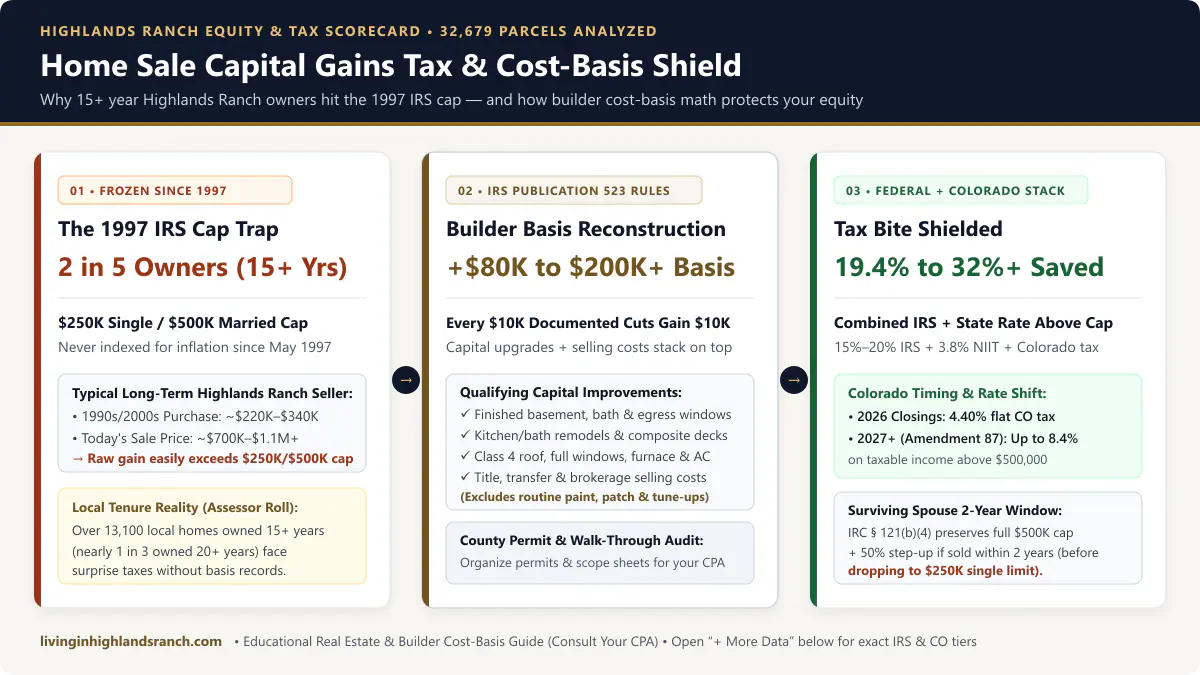
Roughly two out of five Highlands Ranch homeowners have owned for 15+ years, pushing everyday family equity past the federal tax cap frozen since 1997. Before listing, we walk your home with a residential builder’s eye to organize a clean cost-basis file for your CPA.
Why Do Roughly 2 in 5 Longtime Highlands Ranch Sellers Exceed the Federal Tax Exclusion?
When Congress froze the $250,000 single and $500,000 married home-sale exclusion back in May of that era, family houses in Northridge, Eastridge, and Westridge traded for a fraction of today’s values. Half a million dollars of tax-free profit felt untouchable.
Today, roughly two out of five Highlands Ranch homeowners have owned for fifteen years or longer while neighborhood prices across established streets, Backcountry luxury homes, and newer builds climbed past $700,000 to $1.1M+. This guide shares real estate and builder perspective rather than formal CPA or legal tax advice, helping you hand your accountant a rock-solid file.
| Seller Profile | IRS Exclusion | Typical Basis Lift | Kitchen-Table Takeaway |
|---|---|---|---|
| Married (15–25+ Yrs) | $500,000 cap | +$120K–$220K+ | Bought ~$265K, selling ~$875K: upgrades plus selling costs often erase the entire $110K taxable overage. |
| Widowed ≤2 Years | $500,000 + step-up | 50% joint step-up | Selling within 2 years keeps the $500K cap plus a 50% date-of-death basis step-up on jointly held homes. |
| Single / Widowed >2 Yrs | $250,000 cap | +$80K–$180K+ | Lower $250K limit makes documenting roofs, kitchens, basements, and closing fees vital. |
| Luxury ($1.2M–$1.8M+) | $250K / $500K | +$180K–$350K+ | Walkout finishes, outdoor living, and 2026 vs. 2027+ Colorado timing can swing taxes by $35,000+. |
+ More Data (Assessor tenure counts & 90-day REcolorado 3-benchmark $/SqFt)
- Across 32,679 Highlands Ranch residential parcels, 13,186 (40.4%) have been owned 15+ years and 9,905 (30.3%) 20+ years.
- Highlands Ranch (Province Center isolated) sits at 12,926 / 32,143 (40.2%).
- Detached Single-Family sales hit a $715,000 median at $349 Above-Grade / $286 Finished / $244 Total Structure $/SqFt.
How Do Surviving Spouses & Divorcing Owners Protect Their Full $500,000 Exclusion?
Under the surviving spouse window, an unmarried widow or widower who closes within two years of a partner’s passing keeps the full $500,000 cap before dropping to the single limit. On a jointly titled Colorado home, your CPA also evaluates the 50% date-of-death step-up covered in our inherited, probate, and trust home guide.
Divorcing couples get a separate safeguard under IRS rules when one ex-spouse stays in the family house under a divorce decree. Structuring your timeline with your CPA and family attorney before signing a settlement preserves up to $500,000 of combined exclusion.
Colorado’s Tax Stack: 4.40% in 2026 vs. Amendment 87 in 2027+
Colorado taxes net home-sale profit above your federal cap at a flat 4.40% state rate for closings in 2026. Unlike zero-tax states, that state slice stacks right on top of federal capital gains rates.
Starting next year under Colorado’s new graduated income tax measure, state brackets climb up to 8.4% above $500,000 of taxable income, making closing-year timing critical for luxury sellers.
Out-of-state movers also face automatic two-percent title withholding on Form DR 1079 whenever a non-Colorado forwarding address appears at closing. Fortunately, primary-residence sellers who owe zero state tax can sign Form DR 1083 to keep their full check at the table.
+ More Data (IRS 15%/20% LTCG, 3.8% NIIT, Amendment 87 tiers & DR 1079 / DR 1083)
- Taxable gain faces 15% or 20% federal LTCG plus 3.8% NIIT (IRC § 1411) above $200,000 single / $250,000 married MAGI.
- 4.40% flat in 2026 (19.4%–28.2% combined) versus 3.7%–8.4% graduated brackets in TY 2027+ above $500,000 (up to 32.2%+ combined), alongside IRC § 121(b)(4) widow and § 121(d)(3) divorce rules.
- Form DR 1079 withholds the lesser of 2% of sale price or net cash proceeds unless exempted via Form DR 1083.
Which Documented Home Improvements Legally Increase Your IRS Cost Basis?
Many longtime owners worry they lost remodel folders years ago. When we walk through your home together, I never replace your CPA or licensed inspector—instead, I use a builder’s eye to catalog every permanent upgrade you forgot you funded.
Projects like basement finishing and remodeling, composite decks, and custom kitchens add directly to your basis alongside archived Douglas County permits and HRCA approvals. Start with a custom Highlands Ranch home valuation and room-by-room basis review well before listing.
+ More Data (IRS Pub. 523 qualifying upgrades vs. disallowed repairs & hail claims)
- Finished basements, egress windows, kitchen/bath remodels, composite decks, full window/siding replacements, Class 4 roofs, furnaces/ACs, plus title and brokerage selling costs.
- Routine painting, minor fixes, HOA dues, and insurance-paid hail proceeds do not add to basis (only out-of-pocket deductibles and paid Class 4 upgrades count).

Frequently Asked Questions
What if I lost receipts from a basement finish or remodel 15 years ago?
How does the 2-year surviving spouse capital gains rule work in Colorado?
Why do Colorado title companies withhold 2% on Form DR 1079 for out-of-state sellers?

Highlands Ranch Realtor, residential builder, home rehab expert, and engineer who shares general construction knowledge, layout and remodeling ideas for basements, decks, landscaping, and kitchens, and helps clients know what questions to ask independent licensed inspectors.
Planning to sell a long-time Highlands Ranch home and want a builder’s cost-basis walk-through?
Read Saber’s Realtor, Builder & Engineer Bio or reach out directly for a private pre-listing strategy session.