

Highlands Ranch Market Insights
Do Solar Panels Increase Home Value? 6-Year Study

Do Solar Panels Increase Home Value? 6-Year Study
Homeowners ask me all year whether rooftop solar pays off at resale or scares buyers away. Studying six years of local sold-home and Douglas County property records shows paid-off panels add modest value, while monthly buyer-assumed leases face stiff buyer resistance today.
Six Years of Local Home Sales: What Owned vs. Leased Solar Actually Did at Closing
Door-to-door solar reps love quoting national studies that promise tens of thousands of dollars in automatic resale profit. At the closing table in Douglas County, only local buyer offers count.
We studied 7,475 detached listings in local sold-home and Douglas County property records across six years, pairing each solar house against non-solar neighbors of matching half-year, build era, and size. Debt-free panels added roughly $4,000 to $9,000 at resale, though retail installs still cost far more upfront.
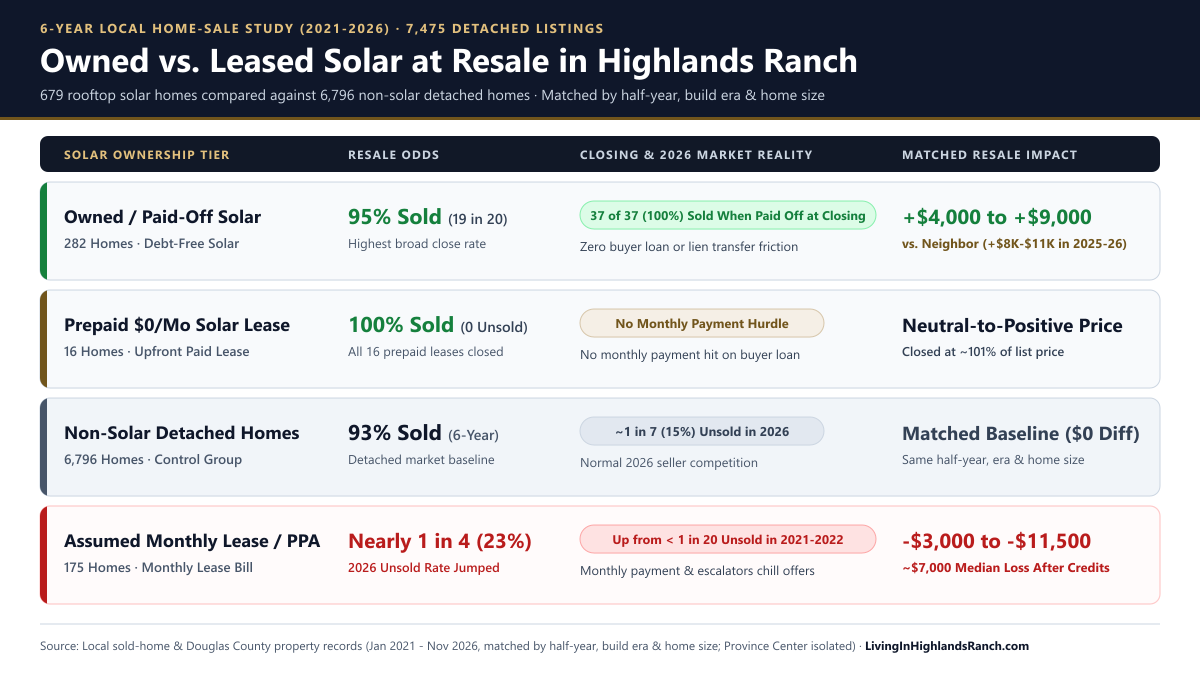
| Solar Tier | Listings & Close Rate | Matched Price Impact | Wallet Takeaway |
|---|---|---|---|
| Owned / Paid-Off | 282 homes; 19 in 20 (95%) sold. | +$4,000 to +$9,000 (+$8K–$11K in 2025–26). | Top broad close rate; appraisers credit owned arrays. |
| Paid Off at Closing | 37 of 37 (100%) sold cleanly. | Preserves full buyer pool. | Eliminates loan assumptions and UCC-1 lien delays. |
| Prepaid $0/Mo Lease | 16 of 16 (100%) sold cleanly. | Neutral to positive (~101% of list). | Zero monthly payment hits buyer borrowing power. |
| Non-Solar Baseline | 6,796 homes; 93% sold (~1 in 7 unsold in 2026). | $0 matched benchmark. | Standard competition with zero solar transfer steps. |
| Assumed Monthly Lease | 175 homes; nearly 1 in 4 (23%) unsold in 2026. | -$3,000 to -$11,500 (~-$7,000 net). | Monthly bill cuts loan power and sparks credit requests. |
+ More Data (Exact counts, 3-benchmark $/SqFt, period splits & build-era cohorts)
- Counts & 3-Benchmark $/SqFt (Above-Grade / Finished / Total Structure): 7,475 detached cycles (6,939 sold, 536 unsold; 679 solar [9.1%] vs. 6,796 non-solar, +/-15% SqFt match): 282 Owned/Paid-Off (245 owned + 37 paid at closing [37/37 = 100.0%]; 95.4% sold, $740K median, $350/$272/$246 $/SqFt), 16 Prepaid $0/Mo Leases (16/16 = 100.0%), 175 Monthly Leases (92.6% sold, $680K median, -$7,200 matched net gap, $343/$274/$236 $/SqFt), 63 Assumed Solar Loans (13.6%+ failure friction), 143 Unspecified Solar ($731,250; $346/$275/$239), and Non-Solar Baseline ($710.1K; $354/$287/$250).
- Period Failures, Build Eras & Province Center: Monthly Lease unsold rates rose 4.3% (2021–22) → 9.5% (2023–26) → 23.1% (2026 YTD, vs. 10.5% Owned / 15.0% Non-Solar) → 50.0% (last 90 days, vs. 20.0% Owned / 27.3% Non-Solar). Eras: 1981–1999 (5,109 cycles, 9.1% solar: Owned 95.3% sold, $356/$277/$253 vs. Leased 92.3%, $344/$272/$240); 2000–2014 (2,013 cycles, 8.5% solar: Owned 92.5%, $340/$254/$229 vs. Leased 89.8%, $330/$262/$226); 2015+ (353 cycles, 4.8% solar: Owned 100.0%, $493/$348/$318; <=3 leased). Province Center isolated: 121 cycles (113 sold, 93.4%, 9 solar).
Data footer: Based on information from REcolorado®, Inc. and Douglas County Assessor public property records (Jan 2021–Nov 2026); not all sales are listed and information is deemed reliable but not guaranteed.
Why 2021 Hid the Solar Lease Trap and Higher Mortgage Rates Exposed It
During the pandemic housing boom, 3% mortgages masked almost every flaw in a solar lease. Fewer than 1 in 20 leased-solar homes went unsold because buyers had ample budget room to absorb an extra monthly bill.
Once mortgage rates climbed, buyer debt-to-income ratios tightened across Douglas County. Every monthly lease dollar trims a financed buyer’s borrowing limit, while Fannie Mae and FHA appraisers assign $0 value to leased panels—pushing 2026 lease failures to nearly 1 in 4.
Annual lease escalators near 3% also erode Xcel Energy savings over time, as detailed in our builder’s guide to owned versus leased solar and HRCA rules. Meanwhile, after the homeowner Section 25D tax credit expired for 2026, installers leaned even harder on leases to capture the corporate Section 48E credit.
How Solar Plays Out Across All Three Highlands Ranch Build Eras
As a Residential Builder and Engineer, I evaluate solar arrays alongside the roof and cooling load underneath them across all three build eras:
- 1980s–1990s Neighborhoods (Northridge, Eastridge & Westridge): Highest solar share over aging shingles, where hail reroof panel detach-and-reset labor runs $4,000 to $8,000 unless insured; see our Colorado hail roof and Class 4 shingle guide.
- 2000–2014 Executive Two-Stories (Firelight, Southridge & Backcountry): Dual-AC two-story plans face steep Xcel 5:00 to 9:00 PM peak cooling bills; paid-off arrays sold well while monthly leases posted our lowest close rate near 90%.
- 2015+ Newer Luxury Builds: Modern energy-code envelopes cut baseline electricity demand, and owned architectural arrays closed 100% of the time over six years.
Negotiating a Solar Home Purchase or Preparing One for Sale
One statistic guides every seller carrying a solar loan or buyout balance: sellers who paid off their contract from closing proceeds went a spotless 37 for 37. By contrast, demanding that buyers assume a separate solar loan triggered repeated fall-throughs over county UCC-1 fixture filings on title.
Before listing through our Maximized Selling System, we pull payoff or buyout quotes and title records early, paired with a custom Highlands Ranch home valuation. When representing buyers, I request 12 months of Xcel bills, roof age, and hail detach-and-reset policy terms so you know the exact questions to ask independent, licensed roofing and electrical inspectors.
Frequently Asked Questions
Should I pay off my solar loan or lease buyout at closing?
How does a prepaid solar lease differ from a monthly solar lease?
What happens to solar panels when hail damages a Highlands Ranch roof?

Highlands Ranch Realtor, residential builder, home rehab expert, engineer, and data-driven master negotiator who shares general construction knowledge, layout and remodeling ideas for basements, decks, landscaping, and kitchens, negotiates with local sold-home and Douglas County property numbers, and helps clients know what questions to ask independent licensed inspectors.
Buying or selling a solar home in Highlands Ranch and want a builder, engineer, and negotiator in your corner?
Read Saber’s Realtor, Builder & Engineer Bio or reach out directly for a personal net-sheet and contract conversation.