

Who Plows Highlands Ranch Streets? County vs. Metro District Guide
Because Highlands Ranch sits in unincorporated Douglas County rather than an incorporated city, winter snow removal is split across four separate crews instead of one municipal street department. Douglas County plows public roads in three priority tiers, the Highlands Ranch Metro District clears arterial parkway walks and hard-surface trails, and CDOT handles C-470 and Santa Fe Drive. Understanding how those routes work helps you plan storm-day commutes, clear your sidewalk on time, and pick a lot that melts winter ice naturally.
Who Plows Streets, Highways, Trails & Private Enclaves
Every March upslope blizzard brings the same surprise for newly relocated homeowners: calling HRCA or looking up a municipal street desk will not get a snowplow dispatched to your cul-de-sac. Because Highlands Ranch operates inside unincorporated Douglas County, winter road, trail, and highway clearing splits cleanly across four distinct agencies.
Knowing which crew owns which pavement saves you wasted phone calls on storm mornings and explains why a main parkway sidewalk can be bare concrete by sunrise while your residential court is still waiting for an afternoon pass.
| Roadway or Surface | Responsible Crew & Contact | Trigger & Homeowner Expectation |
|---|---|---|
| C-470, U.S. 85 (Santa Fe) & I-25 | CDOT State Maintenance · COtrip.org / 511 | Continuous plowing and de-icing across mainline lanes, C-470 Express Lanes, and CO-177 north of County Line Road. |
| Public Arterials, Collectors & Courts | Douglas County Public Works · 303-660-7480 | Over 3,750 winter lane miles plowed by 70 drivers in Priority 1, 2, and 3 order; funded by the Road and Bridge Fund rather than HRCA dues. |
| Arterial Sidewalks & Paved Trails | Highlands Ranch Metro District · 303-791-0430 | Clears 150+ miles of parkway walks and hard-surface trails once 3 inches accumulate or snow stays past 24 hours. |
| Gated Streets, Patio Homes & Condos | Private Sub-Associations & HRCA (Rec Lots Only) | Sub-association contractors typically trigger at 2 to 3 inches; HRCA plows only its 4 recreation center lots. |
| Neighborhood Sidewalks & Driveways | Individual Property Owner or Resident | Must clear bordering front and side residential sidewalks within 24 hours after snowfall ends; stack snow on lawns. |
Douglas County Priority 1, 2 & 3 Routes vs. Metro District Trails
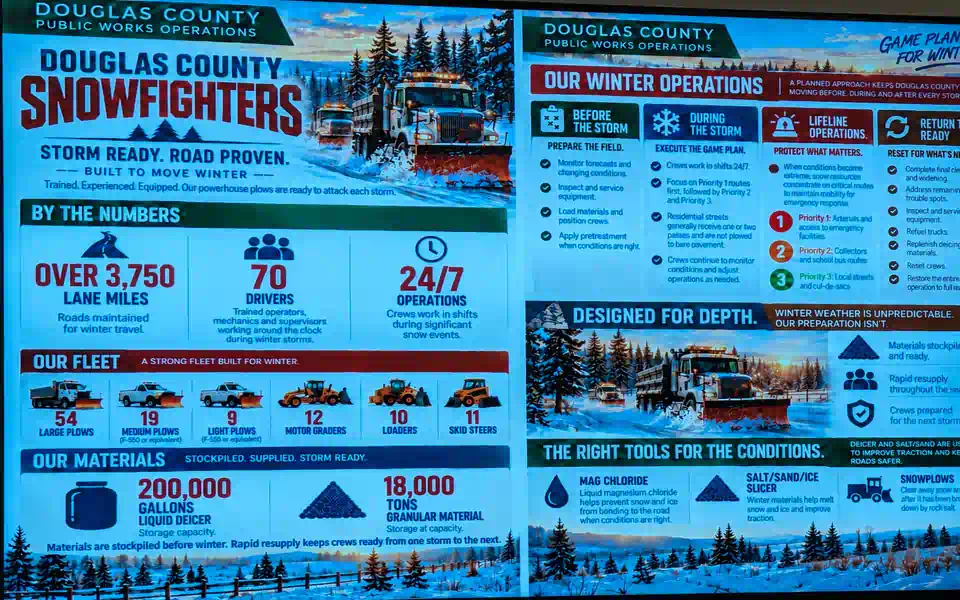
Douglas County Public Works sequences more than 3,750 winter lane miles across unincorporated communities by emergency response access, traffic speed, and school bus connectivity rather than plowing every subdivision at once. Paid through the County Road and Bridge fund rather than quarterly HRCA dues, 70 trained operators rotate through round-the-clock storm shifts when heavy snow hits.
- Priority 1 — Arterial Parkways & Hospital Corridors: Heavy tandem plows stay continuously on major multi-lane parkways throughout active snowfall to keep routes open to UCHealth Highlands Ranch Hospital, Children’s Hospital Colorado South Campus, South Metro Fire Rescue stations, and Sheriff substations. Key Priority 1 corridors include Highlands Ranch Parkway, Wildcat Reserve Parkway, University Boulevard, Lincoln Avenue, Lucent Boulevard, South Broadway, Quebec Street, McArthur Ranch Road, and county-maintained segments of County Line Road.
- Priority 2 — Subdivision Collectors & School Bus Loops: Once snowfall subsides and Priority 1 arterials are clear, county trucks transition onto collector loops and Douglas County School District bus routes — such as Venneford Ranch Road, Foothills Canyon Boulevard, Cresthill Lane, Timberline Road, Westridge Parkway, Redstone Ridge, and Poston Parkway.
- Priority 3 — Local Residential Streets & Cul-de-Sacs: Interior neighborhood streets, places, circles, and courts are plowed after Priority 1 and Priority 2 routes finish. County guidelines give residential streets one or two passes for passable traction rather than bare pavement, unless light snow is expected to melt off naturally within 24 hours or parked cars prevent wide plow blades from passing safely.
How the Traffic Management Center & Snowfighters Run Storm Days
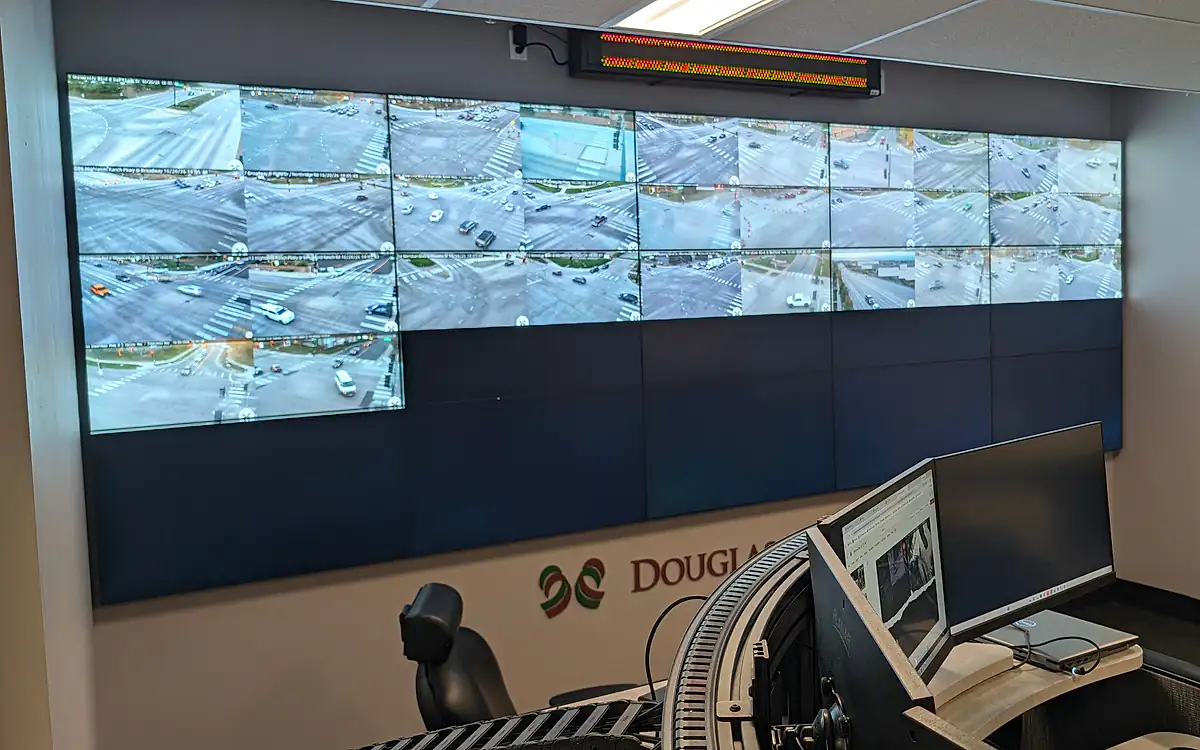
When I toured the Douglas County Traffic Management Center and Public Works facility, watching the live intersection wall side by side made the Priority 1 dispatch order click right away. Staff monitor major corridors like Highlands Ranch Parkway, South Broadway, University Boulevard, and Lincoln Avenue in real time while crews stage equipment ahead of incoming cold fronts.
Meanwhile, residents often hear about Highlands Ranch’s 270+ miles of combined community pedestrian pathways and wonder which walks get cleared automatically. Within that broader network of neighborhood sidewalks, parkway walks, and open-space trails, Highlands Ranch Metro District crews specifically plow 150+ miles of hard-surface corridors — consisting of 38 miles of paved multi-use trails and 112 miles of sidewalks bordering major arterial roads, plus community park parking lots.
Metro District utility tractors roll once 3 inches of snow accumulate or when colder temperatures will keep snow on paved paths past 24 hours. By contrast, the 26 miles of natural-surface dirt trails inside the 8,200-acre Backcountry Wilderness Area are intentionally left unplowed to protect wildlife habitat and fragile winter soils, while private streets behind gates in Backcountry, Mansion Hills, Highwoods, and Falcon Hills rely on sub-association contractors.
The 24-Hour Sidewalk Rule, Driveway Windrows & Cul-de-Sac Storage
Under Douglas County guidelines, homeowners and residents are responsible for clearing snow and ice from every residential sidewalk bordering their lot within 24 hours after snowfall stops so elementary walkers and neighbors are never forced into icy street lanes. If you own a corner lot where the side street is an interior residential collector rather than a Metro District parkway, that side walk belongs to your shovel list too.
- Never Push Snow Into the Street: County guidelines prohibit shoveling or blowing driveway snow out into public asphalt lanes. Street piles freeze into slick ruts before plows arrive and guarantee a twice-as-heavy ice berm across your own apron when the Priority 3 blade passes; toss snow onto your front lawn instead, where winter meltwater gives parched Front Range tree roots free moisture.
- The Upstream Curb-Pocket Trick for Windrows: County snowplows angle blades toward the right curb and cannot raise them at thousands of individual driveways. Shoveling a 6-to-10-foot pocket along the curb to the left of your driveway as you face the street lets most of the blade’s snow load spill harmlessly before crossing your apron.
- Cul-de-Sac Snow Storage & Fire Hydrants: Roughly 1 in 6 local houses sit on cul-de-sac bulb homes, where pie-shaped lots pinch street curb frontage tightly around the turnaround circle. Because plow drivers must tuck snow into narrow gaps between aprons and mailboxes, pulling vehicles off the curb into your garage before a storm and clearing a 3-foot ring around neighborhood fire hydrants keeps your court accessible.
Why Sunny Driveways Command a Premium & How to Protect Concrete
Because Priority 3 residential plows arrive last, compass orientation plays a huge role in daily winter comfort and resale demand. At nearly 6,000 feet of elevation, December and January noon sun sits low in the southern sky and casts roughly a 50-foot shadow behind two-story rooflines, which is why buyers actively seek out south-facing driveway homes for sale in Highlands Ranch or low-maintenance patio homes and lock-and-leave neighborhoods where sub-association crews handle the shoveling.
If your garage faces north, resist dumping bags of magnesium chloride, calcium chloride, rock salt, or leftover lawn fertilizer onto icy concrete. Across our 100+ annual freeze-thaw cycles, de-icing salts trigger sub-surface crystal pressure that flakes surface paste right off the slab — a topic we cover in detail inside our south- vs. north-facing driveway and patio builder guide.
From my perspective as a residential builder and engineer — sharing everyday construction know-how rather than performing a formal inspection — I always suggest shoveling shaded aprons before tire tracks pack snow into glaze ice, keeping angular granite traction grit by the garage door, and coating cured slabs with a breathable penetrating silane-siloxane sealer. When we walk homes together, I help you spot apron settlement, downspout discharge across walkways, and concrete scaling questions to ask your independent, licensed third-party home inspector, while keeping every real estate fee in Colorado 100% individually negotiable outside the MLS rather than set by law.
| Home or Lot Profile | Recent Closed Benchmark | Winter Snow & Shoveling Reality |
|---|---|---|
| Pure South-Facing Detached | ~$745,000 median · 3 in 4 sold | Roughly 3 in 10 detached lots; midday Colorado sun melts light storms and Priority 3 plow ridges fast. |
| All Core Detached Houses | ~$715,000 median · ~4 weeks to contract | Homeowner clears driveway and bordering walk within 24 hours; County plows street on Priority 2 or 3 pass. |
| Cul-de-Sac Bulb Detached | ~$787,000 12-mo median · ~1 in 3 larger lot | Zero cut-through traffic and huge backyards, paired with Priority 3 plowing and tighter front curb snow storage. |
| Pure North-Facing Detached | ~$658,000 median · ~7 in 10 sold | Trades extra winter driveway shoveling (and sunny south backyards) for softer entry pricing. |
| Attached Condos & Townhomes | ~$483,000 median · Contracted snow crew | Private sub-association contractors plow private lanes and shovel walks once storm triggers (often 2 to 3 inches) hit. |
+ More Data (See exact sales counts, 3-benchmark $/SqFt, GIS parcel totals & methodology)
- Closed Sales & GIS Parcel Cohorts (Last 90 Days, Updated Every 30 Days): Core Highlands Ranch detached single-family (excluding standalone Province Center): 341 unique listings, 248 closed sales (72.7% success rate, $715,000 median sold price, 27 median days on market, 64.9% seller concessions averaging $11,228 when given). Attached condos & townhomes: 94 unique listings, 50 closed sales (53.2% success rate, $482,500 median, 58 median days). Standalone Province Center isolated separately: 6 closed of 6 ($668,091 median, 16 median days). Pure South detached cohort: 39 sold of 52 (75.0%, $745,000 median) vs. pure North detached: 16 sold of 22 (72.7%, $657,500 median). Across 32,143 Core HRCA parcels (+ 536 standalone Province Center = 32,679 total parcels), 5,305 Core HRCA homes (16.5%: 4,520 dead-end bulbs + 785 eyebrow pockets; + 76 in Province Center) sit on GIS-verified cul-de-sacs, where 12-month detached resales closed at $786,778 vs. $728,000 non-bulb (8,625 SqFt vs. 6,490 SqFt median lot).
- Three-Benchmark Colorado $/SqFt Split: Core detached single-family averaged $349/Above-Grade SqFt (main + upper levels), $286/Finished SqFt (above-grade + finished basement), and $244/Total Structure SqFt (including unfinished basement footprint); attached condos/townhomes averaged $333/Above-Grade SqFt, $326/Finished SqFt, and $302/Total Structure SqFt; pure South detached averaged $373 / $281 / $246 vs. pure North detached at $357 / $295 / $265; standalone Province Center averaged $344 / $258 / $237.
- Public Works Fleet, Stockpiles & Road Funding Totals: Douglas County Public Works (303-660-7480; main 303-660-7490) maintains 3,750+ winter lane miles using 70 trained drivers on 24/7 storm shifts across 115 snow-fighting units (54 large plows, 19 medium F-550-class plows, 9 light plows, 12 motor graders, 10 loaders, and 11 skid steers), backed by 200,000 gallons of liquid magnesium chloride deicer and 18,000 tons of granular salt/sand/Ice Slicer. County snow removal and road maintenance are funded through Douglas County Road & Bridge Fund 200 (3.731 mills property tax plus auto ownership and state highway user taxes; County retains 100% in unincorporated areas and the Park Meadows ring-road), supplemented for capital/regional projects by Voter-Approved Road Sales & Use Tax Fund 230 (0.40% through Dec. 31, 2030) and Transportation Infrastructure Fund 235 (0.18%). Highlands Ranch Metro District (303-791-0430 / 303-791-2710) plows 150+ miles of hard-surface pathways (38 miles of hard-surface multi-use trails + 112 miles of arterial parkway sidewalks) at a 3-inch / 24-hour snow persistence trigger within the community’s 270+ mile total pedestrian network.
Data footer: Based on information from REcolorado®, Inc., Douglas County Assessor and Public Works Operations records, and Highlands Ranch Metro District published winter maintenance guidelines for the stated period; not all sales are listed and information is deemed reliable but not guaranteed.
Frequently Asked Questions
Who plows residential streets in Highlands Ranch, and when do Priority 3 plows arrive?
Does the Highlands Ranch Metro District or HRCA shovel neighborhood sidewalks?
Where do snowplows stack snow on Highlands Ranch cul-de-sacs, and how can I reduce driveway windrows?

Highlands Ranch Realtor, residential builder, home rehab expert, and engineer who shares general construction knowledge, layout and remodeling ideas for basements, decks, landscaping, and kitchens, and helps clients know what questions to ask independent licensed inspectors.
Planning to buy or sell a home in Highlands Ranch or Douglas County? Put a full-time Realtor® and Master Negotiator with a Builder & Engineer’s eye on your side.
Read Saber’s Realtor, Builder & Engineer Bio or reach out directly for a personal advisory conversation.