

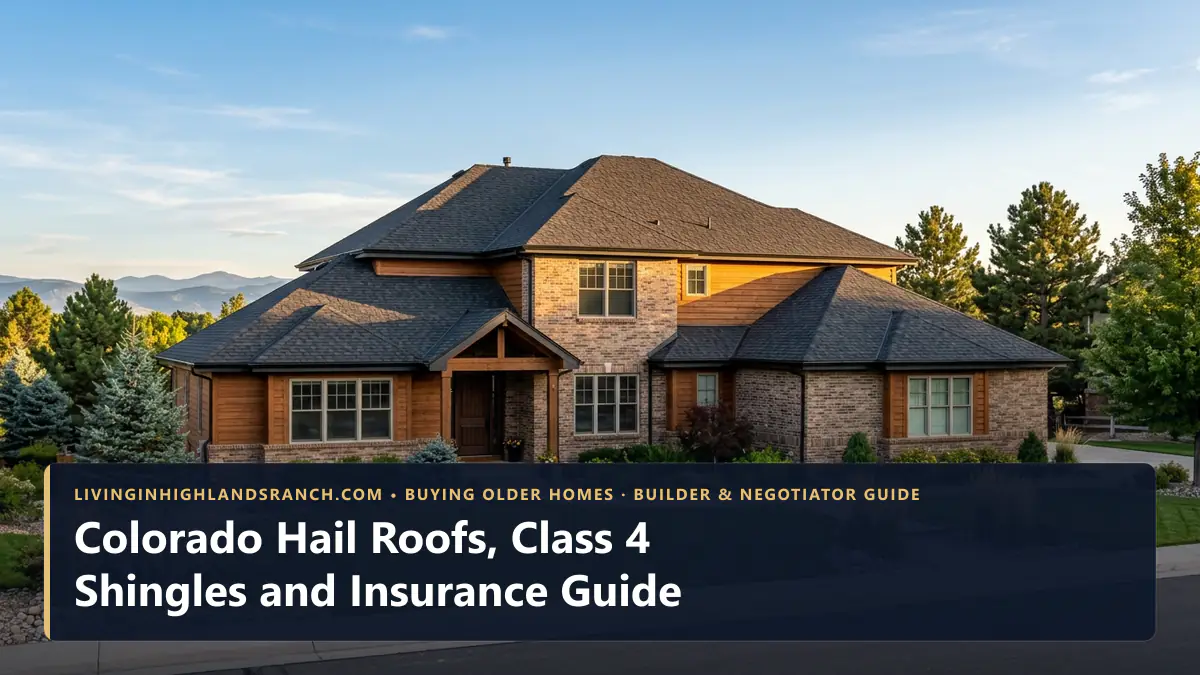
Colorado Hail Roofs, Class 4 Shingles and Insurance Guide
Along the Palmer Divide hail corridor at 5,800 to 6,400 feet of elevation, roof age, impact rating, and insurance bindability represent the top inspection and seller-concession battleground in Douglas County real estate. Across multi-year Highlands Ranch sales (and based on the last 90 days sales report where our sold data is updated every 30 days), 68.1% of all residential closings and 70.5% of 1981 to 1999 established single-family homes ($11,097 average credit across 166 sales, reaching 78.9% and $13,486 in Northridge) required seller concessions—driven heavily by 12-to-20-year composition roofs hitting Actual Cash Value depreciation schedules and percentage wind-and-hail deductibles.
Why Do Roof Age & Hail History Drive Most Older-Home Seller Concessions?
Highlands Ranch sits where moist upslope air off the South Platte River Valley collides with the Palmer Divide between 5,800 and 6,400 feet above sea level. Combined with 300+ days of high-altitude ultraviolet exposure and rapid winter freeze-thaw swings, standard oxidized asphalt shingles age 30% to 40% faster along the southern Front Range than at lower elevations. When a home goes under contract, the roof is evaluated simultaneously by the buyer’s independent licensed home inspector, a licensed roofing contractor, the mortgage appraiser, and the property insurance underwriter.
Across multi-year Highlands Ranch sales—and in the last 90 days sales report across 248 closed Core detached single-family homes out of 341 unique properties (with Province Center isolated standalone and our sold data updated every 30 days)—68.1% of all transactions and 64.9% of recent Core detached closings required seller concessions averaging $11,228 when given.
Across all three Highlands Ranch build eras, the impact of roof age and material tier is clear:
- 1981 to 1999 Established Era (Northridge, Eastridge, Westridge, Early Southridge): Across 166 detached sales ($702,500 median; $355 Above-Grade, $286 Finished, and $250 Total Structure $/SqFt), 70.5% of sellers paid concessions averaging $11,097. In Northridge ($665,000 median and 34.5% listing failure rate), where many roofs installed after 2009 to 2014 hailstorms are now 12 to 17 years old, concessions reached 78.9% averaging $13,486.
- 2000 to 2014 Executive Era (Firelight, The Hearth, Tresana, Highlands Ranch Golf Club, Early Backcountry): Across 62 detached sales ($720,000 median; $332 Above-Grade, $279 Finished, and $229 Total Structure $/SqFt), 61.3% of sellers paid concessions averaging $11,248, including 75.0% ($14,850 average) in The Hearth and 62.5% ($12,142 average) in Firelight.
- 2015 to Present Newer Luxury & Brand-New Construction (Backcountry, Central Park, Westridge Infill): Across 20 detached sales ($1,224,975 median; $478 Above-Grade, $320 Finished, and $304 Total Structure $/SqFt), only 30.0% required concessions ($13,667 average), dropping to 23.1% in Backcountry ($1,360,000 median, 3 median days on market, 76.9% cash buyers) where concrete tile and Class 4 roofs dominate.
| Segment / Roof Tier | Sold & Fail % | Median Sold & 3-Benchmark $/SqFt | Concession % (Avg $) & Med DOM | Builder & Insurance Takeaway |
|---|---|---|---|---|
| 1981–1999 Established SFR | 166 Sold / 59 Failed (26.2% fail). | $702,500 ($355 / $286 / $250 SqFt). | 70.5% ($11,097 avg); 22d DOM. | Check closed permit, 1-layer tear-off, and skylight flashing. |
| 2000–2014 Executive SFR | 62 Sold / 29 Failed (31.9% fail). | $720,000 ($332 / $279 / $229 SqFt). | 61.3% ($11,248 avg); 39d DOM. | 12-to-20-year asphalt roofs hit ACV schedules; check tile valleys. |
| 2015–Present Newer Luxury SFR | 20 Sold / 5 Failed (20.0% fail). | $1,224,975 ($478 / $320 / $304 SqFt). | 30.0% ($13,667 avg); 26d DOM. | Verify Class 3 vs. UL 2218 Class 4 shingles for insurance discounts. |
| HRCA Level 1 & 2 Composition Roofs | 203 Sold / 73 Failed (26.4% fail). | $700,000 median (81.9% of sales). | 67.0% ($11,259 avg); 28d DOM. | Upgrading to SBS-modified Class 4 removes top inspection friction. |
| HRCA Level 3 Tile & Stone-Coated Steel | 38 Sold / 17 Failed (30.9% fail). | $915,000 median sold price. | 52.6% ($10,561 avg); 12d DOM. | Closes 16 days faster with 14.4 points fewer concessions. |
How Do UL 2218 Class 4 Impact Shingles Compare Across HRCA’s Approved Roof Levels?
Standard Level 1 or entry-level architectural shingles use oxidized asphalt, which loses volatile oils under high-altitude UV rays and turns brittle in cold weather. Premium UL 2218 Class 4 impact-resistant shingles (tested by dropping a 2-inch steel ball from 20 feet onto the shingle mat without fracturing) use SBS polymer-modified rubberized asphalt or reinforced backing mesh that absorbs hail impact energy, retains granules, and earns 10% to 25%+ annual Colorado wind-and-hail insurance premium discounts.
Under Section 2.63 of the Highlands Ranch Community Association Residential Improvement Guidelines, all roof replacements require prior written approval from the HRCA Architectural Review Committee at the Eastridge office (9568 University Boulevard) before work begins. See our HRCA approvals guide for exterior updates for submittal timelines, and always review property-specific HOA architectural disclosures during due diligence. HRCA Section 2.63 groups roofs into three material tiers (allowing like-for-like replacement or an upgrade to a higher tier, never a downgrade):
- HRCA Level 1 (Standard Composition): Conventional 3-tab, T-lock, or standard laminated 2-ply fiberglass shingles carrying Class 3 impact ratings.
- HRCA Level 2 (Dimensional & UL 2218 Class 4 Premium Composition): Heavily textured dimensional shingles, including SBS-modified UL 2218 Class 4 lines (Malarkey Legacy or Vista, Owens Corning Duration Flex, GAF Timberline AS II, CertainTeed NorthGate). Pre-approved to replace legacy 1980s cedar wood shakes and discontinued Woodruff roofs.
- HRCA Level 3 (Concrete/Clay Tile, Composite Slate & Stone-Coated Steel): Clay or concrete tiles, composite shake/slate, and stone-granule-coated stamped steel tiles. Exposed-fastener corrugated metal, copper, aluminum, and full-house standing-seam metal roofs are not approved for entire roofs in Highlands Ranch (standing-seam is limited to small accents like bay windows or porch roofs).
Douglas County Building Code: 1-Layer Tear-Off, Kick-Out Flashing and Roof-as-a-System Checks
Because Highlands Ranch sits in unincorporated Douglas County, any re-roofing or repair exceeding one roofing square (100 square feet) requires a permit and inspection from the Douglas County Building Division. From a Residential Builder and Engineer perspective, five technical details separate a durable roof system from a cosmetic shingle swap when preparing questions for an independent licensed home inspector and licensed roofing contractor:
- Mandatory 1-Layer Tear-Off to Bare Sheathing: Unincorporated Douglas County prohibits overlaying a second layer of asphalt shingles (maximum 1 layer allowed). Tearing off to the bare deck lets roofers replace delaminated OSB panels, re-nail loose decking, and deck over old skip-sheathing.
- Ice Barrier, Drip Edge & Mandatory Kick-Out Flashing: County code requires 90-mph wind-rated shingles below 7,000 feet of elevation (and 120-mph wind ratings with code-mandated eave ice barrier at or above 7,000 feet), metal drip edge on eaves and rakes, 4-by-4-inch step flashing, and mandatory kick-out diverter flashing at every roof-to-sidewall termination to keep water out of stucco and siding.
- The 600-Pound Dead-Load Cap: Douglas County prohibits wood shakes and caps total roof weight at 600 pounds per 100 square feet without a stamp from an independent Colorado-registered Professional Engineer—making lightweight stone-coated steel (150 to 200 lbs/sq) or Class 4 asphalt (250 to 350 lbs/sq) ideal when trusses were not engineered for 950-lb concrete tile.
- Skylight Flashing & Balanced Attic Ventilation: Re-roofing around brittle 1990s acrylic bubble skylights invites leaks; see our guide on evaluating and replacing older skylights to coordinate Low-E tempered glass units and continuous soffit-to-ridge attic ventilation during tear-off.
- 6-Inch Gutters & Bentonite Soil Grading: Upgrading hail-dented 5-inch gutters to 6-inch seamless K-style gutters with 3-by-4-inch downspouts discharging 5 to 6 feet past the foundation prevents roof runoff from swelling expansive clay soils, as detailed in our foundation health and expansive soils guide.
How Do ACV vs. RCV Roof Policies, Percentage Deductibles & Escrow Holdbacks Work?
Most Colorado insurers now apply a percentage wind-and-hail deductible tied to your total dwelling coverage, so an eight-hundred-thousand-dollar policy often carries an $8,000 to $16,000 out-of-pocket hail deductible. Even worse, once a standard composition roof passes 10 to 15 years of age, carriers routinely switch coverage from full replacement cost to an Actual Cash Value depreciation schedule. That sudden underwriting shift is the main reason financed buyers push so hard for roof concessions during inspection, as shown in the comparison table above. Because mortgage lending rules cap how much a seller can credit toward closing costs, you cannot simply hand a buyer a large check at the closing table to pay for a full tear-off. As I explain in our seller concessions negotiation guide, we protect our buyers and sellers using four proven contract solutions under the standard Colorado purchase contract:
- CREC Inspection (§ 10.3) & Property Insurance Objection (§ 10.5): Within the first 5 to 7 days of contract, obtain a written insurance binder quote and CLUE loss-history check while your independent licensed home inspector and licensed roofer inspect soft-metal collateral strikes (furnace B-vents, box vents, gutters) and confirm on Douglas County’s permit portal that prior roof permits were Finaled and Closed.
- Pre-Closing Seller Claim + Buyer Class 4 Upgrade: When an RCV policy covers hail damage, the seller files the claim and pays their deductible to unlock recoverable depreciation while the buyer pays the incremental $2,000 to $3,500 upgrade for a UL 2218 Class 4 shingle in an HRCA-approved color.
- Lender-Approved 1.5x Title Escrow Holdbacks: When closing occurs before roof work finishes, we structure a lender-approved title company escrow holdback holding 1.5 times the licensed contractor’s written bid from seller proceeds, released directly to the roofer only upon Douglas County final permit sign-off and lien waiver.
- Colorado Anti-Rebate Law (C.R.S. § 6-22-105): Colorado law prohibits roofers from waiving or rebating insurance deductibles and mandates a 72-hour right of rescission plus full deposit refund if an insurance claim is denied.
Frequently Asked Questions
Does unincorporated Douglas County allow a second layer of asphalt shingles over an existing roof?
Can a roofing contractor in Colorado legally waive or rebate my hail insurance deductible?
How do buyers and sellers close on a Highlands Ranch home when the roof needs replacement before winter?

Highlands Ranch Realtor, residential builder, home rehab expert, and engineer who shares general construction knowledge, layout and remodeling ideas for basements, decks, landscaping, and kitchens, and helps clients know what questions to ask independent licensed inspectors.
Want a builder, engineer, and master negotiator in your corner before buying or selling in Highlands Ranch?
Read Saber’s Realtor, Builder & Engineer Bio or reach out directly for a personal roof, remodel, or negotiation strategy conversation.