

Highlands Ranch Market Insights
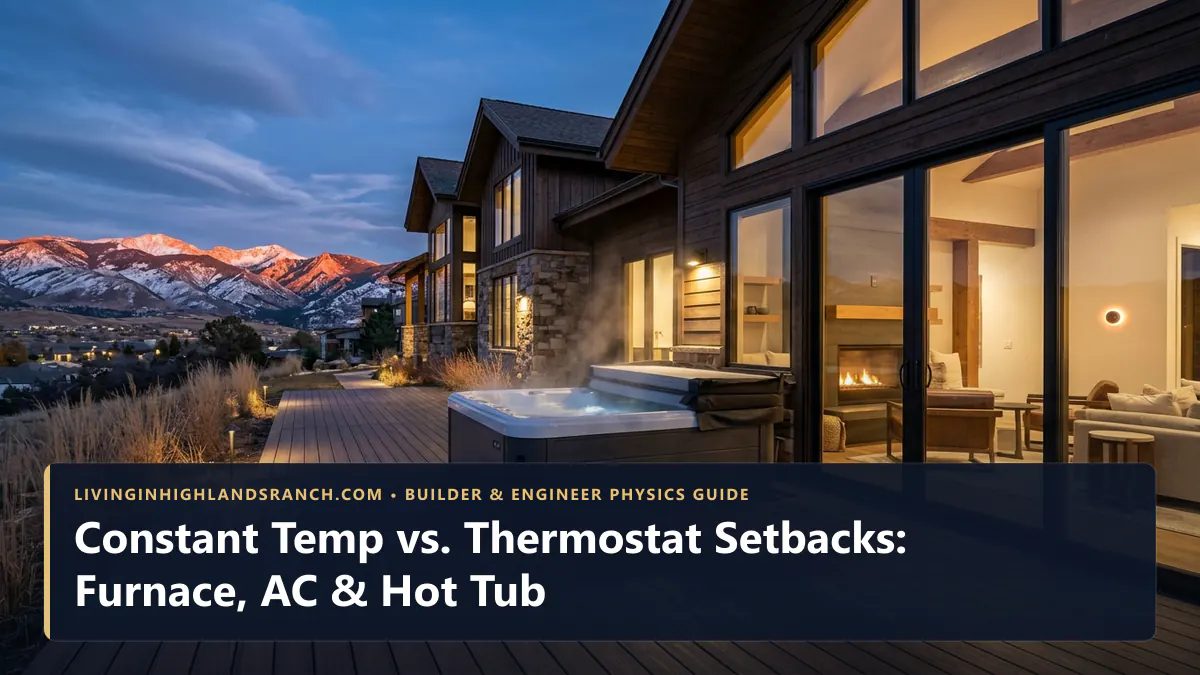
Constant Temp vs. Thermostat Setbacks: Furnace, AC & Hot Tub

Constant Temp vs. Thermostat Setbacks: Furnace, AC & Hot Tub
Few homeownership debates cause more frustration than deciding whether to hold a constant indoor temperature or program a thermostat setback that lets your home cool down and kick back on later. When you apply pure thermodynamics alongside Xcel Energy Colorado’s updated 5:00 PM to 9:00 PM Time-of-Use rate schedule, the winning strategy changes dramatically between a natural gas furnace, a central air conditioner, a heat pump, and a 400-gallon backyard hot tub.
Fourier’s Law & Conservation of Energy: Why the “Works Harder to Catch Up” Myth Fails on Raw BTUs
Every winter across Douglas County, homeowners hear the popular claim that letting a house cool down overnight forces the furnace to work twice as hard in the morning, burning more energy than holding a steady 70 degrees. In pure thermodynamics, that claim violates both Fourier’s Law of Heat Conduction and the First Law of Thermodynamics when measuring raw thermal energy in British Thermal Units (BTUs).
Heat transfer through exterior walls, attic insulation, and windows follows the equation Q = U × A × ΔT, where Q is hourly heat loss (BTU/hr), U is envelope thermal transmittance (1/R-value), A is surface area, and ΔT is the indoor-to-outdoor temperature difference. Because U and A are fixed for your house, heat loss speed depends strictly on ΔT.
- Smaller Temperature Gap Slows Heat Loss: On a 20-degree Highlands Ranch winter night, holding 70 degrees inside creates a 50-degree gap (ΔT = 50°F). Dropping to 62 degrees overnight shrinks that gap to 42 degrees (ΔT = 42°F), cutting conductive heat loss by 16% every hour the home sits at 62 degrees.
- Conservation of Energy at Recovery: The heat energy required at 6:00 AM to warm the air, drywall, and furniture from 62 degrees back to 70 degrees equals only the stored heat lost during the drop, minus the BTUs that never leaked outside while ΔT was smaller.
- Single-Stage Furnaces Fire at One Fixed Rate: A single-stage gas furnace has no gas pedal; it burns fuel at 100% capacity whether recovering 1 degree or 8 degrees, running one continuous 35-minute recovery cycle instead of ten short cycles overnight.
Xcel Energy’s 5:00 PM to 9:00 PM Time-of-Use Shift & The 4-System Scientific Scorecard
If letting temperatures drift always saves raw BTUs, why do engineers advise keeping temperatures steady—or pre-cooling and pre-heating—on central air conditioners, heat pumps, and hot tubs? Because utility bills are measured in dollars, not raw BTUs: Dollars = (BTUs ÷ Equipment Efficiency) × Hourly Tariff Rate.
Most older Colorado HVAC blogs still cite Xcel Energy’s retired 1:00 to 3:00 PM Mid-Peak and 3:00 to 7:00 PM On-Peak schedule. Under Xcel Energy Colorado’s current Residential Time-of-Use schedule (Schedule RE-TOU), Mid-Peak was eliminated and On-Peak moved to 5:00 PM to 9:00 PM Monday through Friday (non-holidays). All 20 other weekday hours from 9:00 PM to 5:00 PM the next day—including the entire sunny 1:00 PM to 5:00 PM afternoon—plus 100% of weekends and holidays are billed at Off-Peak rates (7.88 cents per kWh summer and 6.79 cents per kWh winter base, versus 21.28 cents summer On-Peak and 18.33 cents winter On-Peak, a 2.70x multiplier before riders).
| Home System | Winner for Dollar Savings | Winner for Comfort | Thermodynamic & Xcel Schedule RE-TOU Proof |
|---|---|---|---|
| 1. Natural Gas Furnace (80% to 96% AFUE) | Setback wins (drop 5 to 8 degrees for 8 hours to save 6% to 10%/yr). | Constant temp (or scheduled recovery 45 minutes before waking). | Xcel natural gas is billed per therm at a flat 24/7 rate with zero peak pricing, and gas burner efficiency does not drop at 6:00 AM. On 2-stage condensing furnaces, cap setbacks at 4 to 5 degrees to preserve low-fire condensing mode. |
| 2. Central Air Conditioner (SEER2 Summer) | Keep steady and pre-cool by 2 degrees between 2:00 PM and 4:55 PM. | Keep steady and pre-cool wins by keeping interior drywall cool all evening. | Letting a house float to 78 degrees and kicking A/C on at 5:15 PM forces full load into Xcel’s 5:00 to 9:00 PM On-Peak window (21.28 cents vs. 7.88 cents Off-Peak, 2.70x cost) while hot outdoor air lowers Carnot efficiency by 20% to 30%. |
| 3. Cold-Climate Heat Pump (Winter) | Keep constant within 1 to 2 degrees and pre-warm from 2:00 to 4:55 PM. | Keep constant wins with steady, draft-free 95-degree supply air. | Overnight setbacks force recovery at 6:00 AM when outdoor temperatures and COP are lowest, triggering 10 to 15 kW electric resistance backup strips (COP 1.0) that burn 3x more electricity than holding a steady setpoint. |
| 4. Backyard Hot Tub (400 Gal at 102°F) | Keep constant (100 to 102°F) with a 5:00 to 9:00 PM heater lockout. | Keep constant wins with zero 2.5-hour reheating wait. | 3,336 lbs of water holds 3,336 BTUs/°F and cools only 1.0 to 1.5°F overnight under a tight cover, so daily drops save under 1% kWh. Locking out the 5.5 kW heater from 5:00 to 9:00 PM shifts soak recovery to 9:01 PM Off-Peak rates, saving 63%. |
The 400-Gallon Backyard Hot Tub Paradox: Why Water Defies Daily Setbacks (& The 9:01 PM Recovery Rule)
At Highlands Ranch’s 5,920-foot elevation, all 24,000 cubic feet of air inside a 3,000-square-foot home weighs roughly 1,560 pounds with a low specific heat of 0.24 BTU/lb·°F, requiring only 375 BTUs to change the air temperature by 1 degree (or roughly 2,800 BTUs/°F with surface drywall). By contrast, a 400-gallon hot tub holds 3,336 pounds of water with a specific heat of 1.00 BTU/lb·°F—more than four times higher than air by weight and 3,400 times denser by volume. Raising 400 gallons of water by 1 degree requires 3,336 BTUs, nearly nine times the thermal energy of all the air inside your house.
- Why Daily Hot Tub Setbacks Save Less Than 1% kWh: Under a tight R-16 foam cover on a 25-degree night, a 102-degree spa (ΔT = 77°F) loses only 350 to 500 BTUs/hr. Turning the heater off for 8 hours lets those 3,336 pounds of water cool by just 1.0 to 1.5 degrees (to 100.5°F), shrinking average ΔT by less than 1% (about two cents per night) while a 10-degree setback takes a 5.5 kW heater over two hours to recover.
- When Lowering a Hot Tub Pays Off (The 4-Day Rule): Dropping your spa to 80 or 85 degrees saves real energy only when unused for 4 or more consecutive days, where holding ΔT at 57 degrees instead of 77 degrees cuts multi-day standby loss by 26%.
- The 5:00 PM to 9:00 PM Heater Lockout Hack: Lifting the cover for a 7:00 PM weeknight soak normally triggers the 5.5 kW heater right inside Xcel’s 5:00 to 9:00 PM On-Peak window (2.70x cost). Keeping the tub at a constant 102 degrees with a 5:00 to 9:00 PM heater lockout lets you soak at 7:30 PM (losing only 1.5 degrees) and delays reheating until 9:01 PM on 6.79-cent winter Off-Peak power, cutting recovery cost by 63%.
Because a filled 400-gallon spa with four adults places over 4,800 pounds of load on its footprint and requires a 240-volt, 50-amp or 60-amp GFCI subpanel, review structural support in our deck building and replacement guide and panel capacity in our older-home electrical rehab cost guide.
How Your Home’s Build Era Changes Thermal Drift, Basement Balancing & Seller Concessions
In Fourier’s equation (Q = U × A × ΔT), the U-factor of your home’s exterior shell determines how quickly indoor temperatures drift when the furnace or air conditioner cycles off. Across Highlands Ranch, residential construction spans three distinct build eras, and each era responds differently to thermostat setbacks, finished basement HVAC return-air balancing, and inspection negotiations when you browse active Highlands Ranch homes for sale.
| Build Era & Representative Neighborhoods | 90-Day Median Sold & 3-Benchmark $/SqFt | Seller Concessions (% & Avg Credit) | Envelope Thermal Drift & Thermostat Strategy |
|---|---|---|---|
| 1981–1999 Established Era (Northridge, Eastridge, Westridge, Early Southridge) | $702,500 Median Sold (166 closed) · $355 Above-Grade / $286 Finished / $250 Total $/SqFt. | 70.5% paid concessions, avg $11,097 (22 Median True CDOM). | 2x4 walls (R-11 to R-13), settled attic insulation, and 80% AFUE furnaces make 6 to 8 degree winter setbacks effective; seller credits often fund attic sealing or HVAC updates. |
| 2000–2014 Executive & Custom Wave (Firelight, Tresana, The Hearth, Early Backcountry) | $720,000 Median Sold (62 closed) · $332 Above-Grade / $279 Finished / $229 Total $/SqFt. | 61.3% paid concessions, avg $11,248 (39 Median True CDOM). | 2x6 framing (R-19), Low-E glazing, and 92% to 96% 2-stage furnaces hold heat longer; use a 4 to 5 degree winter setback and 2:00 to 4:55 PM summer pre-cooling. |
| 2015–Present Modern Luxury Era (Later Backcountry Enclaves & Custom Builds) | $1,224,975 Median Sold (20 closed) · $478 Above-Grade / $320 Finished / $304 Total $/SqFt. | 30.0% paid concessions, avg $13,667 (26 Median True CDOM). | Tight envelopes (R-21+ walls, R-49 attics) lose only 0.2 to 0.4°F/hr; pair steady setpoints with pre-4:55 PM thermal banking to coast through the 5:00 to 9:00 PM peak. |
Sharing a builder and engineer’s perspective helps buyers and sellers evaluate insulation, window seals, duct sizing, and panel amperage—and know what to ask licensed inspectors. Comparing HVAC quotes or planning a 240-volt hot tub? Text or send your build era, furnace/panel specs, and bid numbers for a free second-opinion check on Xcel payback, rebates, resale ROI, and installer questions while your licensed contractor handles formal load sizing.
Frequently Asked Questions
Does a gas furnace work harder and burn more fuel recovering from an overnight thermostat setback?
Should I let my house warm up during a summer workday and kick the air conditioner on when I get home at 5:15 PM?
When does lowering a hot tub thermostat actually save electricity in a Colorado winter?

Highlands Ranch Realtor, residential builder, home rehab expert, and engineer who shares general construction knowledge, layout and remodeling ideas for basements, decks, landscaping, and kitchens, and helps clients know what questions to ask independent licensed inspectors.
Comparing HVAC quotes or want a builder and engineer’s second opinion on payback and resale ROI?
Read Saber’s Realtor, Builder & Engineer Bio or text/send your home’s build era and quote numbers for a free second-opinion payback check.