
Modernizing Vaulted Ceilings & 1990s Fireplaces in Highlands Ranch
Over half of our detached homes date to the 1990s, when builders paired vaulted ceilings with dark switched outlets and deep tube-TV cutouts. From a residential builder and engineer’s perspective, I share how to close old niches flush, brighten sloped ceilings, and build quiet, cool-wall linear fireplace walls.
How Do You Close an Outdated 1990s Drywall TV Niche Cleanly?
Walk into almost any 1990s two-story home in Westridge, Northridge, or Eastridge and you spot that deep drywall box beside the fireplace right away. Production builders framed two-foot-deep cavities for heavy tube sets long before thin flat-panel screens existed.
Local sold-home and Douglas County property records show why this wall dates so many listings on sight. Over half of our detached homes date to the 1990s, and more than nine in ten include a fireplace.
- 1980s–1990s Vaulted Tracts (~$703K Median): Scissor-truss vaults in Northridge, Eastridge, and Westridge often pair zero ceiling downlights with deep CRT drywall niches, brass B-vent inserts, and knockdown texture.
- 2000s–2014 Great Rooms (~$720K Median): Taller two-story plans in Backcountry, Tresana, and Firelight added stacked art cutouts, unsealed 6-inch incandescent cans, and corner tile hearths.
- 2015+ Modern Builds (~$1.22M Median): Newer luxury floor plans combine airtight 3000K LED wafers, flush linear direct-vent hearths with quiet blowers, and recessed media conduit.
Hanging a swivel bracket across an open niche leaves a dark dust trap behind your television. Framing flush studs, adding solid plywood backing, and skimming smooth erases the cutout and complements opening 1990s main-floor sightlines. Never bury a live electrical splice behind drywall; have a licensed electrician relocate receptacles and pull low-voltage conduit first.
| Upgrade Scope | Typical Installed Range | Builder, Code & Resale Takeaway |
|---|---|---|
| Flush Drywall TV Niche Closure + Blocking | ~$1,200 – ~$2,800 | Frames flush studs with plywood TV backing, recessed power/conduit box, texture blend, and wall repaint (~$2,500–$5,500 with lower built-in cabinetry). |
| 6–10 Sloped ICAT Gimbaled LED Wafers | ~$1,600 – ~$3,400 | Adds permitted 2700K–3000K airtight gimbaled wafers on smart dimmers (~$185–$325 each) without breaking sloped attic vapor barriers. |
| Linear Gas Fireplace + Whisper Blower & Cool-Wall | ~$8,500 – ~$18,500 | Replaces brass B-vent boxes with a sealed linear unit, recessed 120V variable-speed blower, passive ceiling heat plenum, steel framing, and slab or stone. |
| Flattening 1990s 45-Degree Angled Corner Hearth | ~$9,500 – ~$19,500 | Reclaims dead corner floor triangles with a flat floor-to-ceiling feature wall within manufacturer SLP rigid-pipe rise-to-run tables. |
| Two-Story Foyer & Great-Room Acoustic Package | ~$1,800 – ~$6,000 | Combines felt-backed white-oak acoustic slat panels, lined 16-to-18-foot drapery, and dense wool rug pads to calm upstairs bedroom noise transfer. |
+ More Data (Exact two-story & build-era sales counts, 3-benchmark $/SqFt & Province Center isolation)
| Home Cohort | Closed Sales | Median Price | Median Days | Main & Upper $/SqFt | Finished $/SqFt | Full Footprint $/SqFt |
|---|---|---|---|---|---|---|
| 1981–1999 Core Detached | 166 of 225 (73.8%) | $702,500 | 22 days | $355 | $286 | $250 |
| 2000–2014 Core Detached | 62 of 91 (68.1%) | $720,000 | 39 days | $332 | $279 | $229 |
| 2015+ Newer Luxury Detached | 20 of 25 (80.0%) | $1,224,975 | 26 days | $478 | $320 | $304 |
| Two-Story Detached Cohort | 179 of 252 (71.0%) | $730,000 | 26 days | $332 | $267 | $233 |
| Core Detached Baseline | 248 of 341 (72.7%) | $715,000 | 27 days | $349 | $286 | $244 |
| Attached Condos & Townhomes | 50 of 94 (53.2%) | $482,500 | 58 days | $333 | $326 | $302 |
| Standalone Province Center | 6 of 6 (100.0%) | $668,091 | 16 days | $344 | $258 | $237 |
- 1981–1999 Benchmark $/SqFt Split: Classic detached resales closed at $355 $/Above-Grade SqFt, $286 $/Finished SqFt, and $250 $/Total Structure SqFt across 166 sales, with 70.5% paying credits ($11,097 average).
- Two-Story Seller Credits: Two-story detached sellers provided closing credits on 67.6% of sales over the last 90 days, averaging $11,587 per credit.
- Assessor Vaulted & Hearth Share: Out of 27,919 Core detached parcels, 15,691 date from 1990–1999 (56.20%) and 22,088 use two-story layouts (79.11%). Fireplaces appear in 26,056 detached homes (93.33%).
- Attached & Province Center Scope: Fireplaces appear in 3,715 of 4,224 Core attached homes (87.95%), while 536 standalone Province Center parcels sit outside HRCA and are tracked separately.
- Code & Hearth Manual Checkpoints: Licensed trades pull Douglas County permits under IECC Zone 5B ICAT rules, NEC 210.12 AFCI circuits, IFGC fuel-gas rules, ANSI Z21.88 screens, and manufacturer clearance manuals.
Data footer: Based on information from REcolorado®, Inc. and Douglas County Assessor public property records for the last 90 days sales report; not all sales are listed and information is deemed reliable but not guaranteed.
Which Sloped LED Downlights Prevent Glare and Winter Ice Dams?
Original 1990s vaulted living and family rooms often relied on a single switched corner outlet or one wobbly fan on a long downrod. Even where builders added recessed cans, flat baffles shine sideways into your eyes rather than down onto seating.
Unsealed can housings also act like miniature chimneys inside shallow scissor-truss cavities where insulation is already pinched. Escaping indoor warmth melts roof snow and feeds winter refreeze cycles, as detailed in our attic insulation and ice-dam guide.
- ICAT Airtight Gasket Rating (Climate Zone 5B): Specify Insulation Contact Air-Tight LED wafers with closed-cell foam gaskets and remote metal driver boxes (~$185–$325 installed) so blown fiberglass or mineral wool stays sealed tight.
- Gimbaled 30-to-45-Degree Regressed Optics: Flat wafer pucks glare harshly on 4:12 to 8:12 pitches; choose deep regressed gimbaled trims that tilt straight down to the floor or graze fireplace stonework.
- Warm 2700K–3000K High-CRI Dimming (90+ CRI): Skip bluish 4000K–5000K bulbs that make Colorado evening rooms feel sterile; lock selectable switches to 2700K or 3000K on ELV/TRIAC smart dimmers.
- Scissor-Truss Fishing & Fan Box Bracing: Licensed electricians fish Romex parallel to truss webs with minimal drywall patches and replace plastic boxes on 16-foot ridges with UL-listed 70-pound sloped fan braces.
If your 1980s or 1990s breaker panel is crowded or uses older breaker brands, review our older-home electrical rehab guide before adding multi-zone dimmer circuits.
What Framing, Blowers, and Plenums Upgrade Linear and Corner Gas Fireplaces?
Once you close a side TV cutout, unifying the off-center oak mantel and brass B-vent insert into one centered floor-to-ceiling hearth wall anchors the main level. Buyers touring ~$700,000-plus homes spot the difference between a sealed direct-vent gas flame and a shallow plug-in electric wall heater right away.
Still, many decorative linear gas fireplaces disappoint in winter when ordered without an internal fan. Without forced airflow, an un-blown decorative firebox sends most radiant and convective warmth up the concentric flue instead of pushing heat across an 18-foot vaulted room.
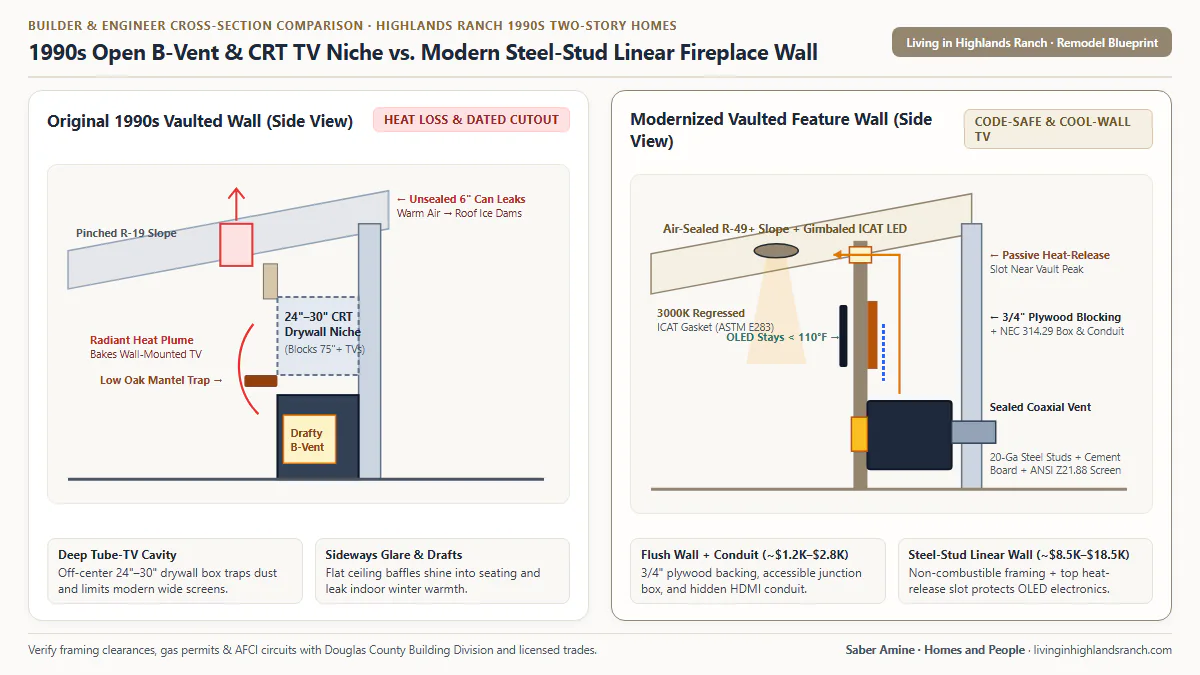
- Quiet 120V Variable-Speed Whisper Blowers (~$350–$650 Add-On): Have a licensed electrician wire a dedicated recessed 120V receptacle inside the lower service cavity during rough-in. Variable-speed rheostat or thermostatic whisper blowers push warm air quietly without noisy 1990s sheet-metal fan hum.
- Passive Cool-Wall & HeatShift Plenums: Upper convection plenums channel rising firebox heat to a discreet ceiling-line slot above the TV. Your OLED or QLED screen mounts flush without a bulky heat-deflecting mantel shelf when homeowners and licensed fireplace installers follow the exact manufacturer framing and combustible clearance manual.
- 20-Gauge Steel Studs & Cement Board: Linear gas fireboxes require galvanized steel studs and listed cementitious backer board rather than paper-faced drywall inside the immediate heat zone. Add a recessed media box and 1.5-inch conduit so HDMI cords stay hidden.
- High-Altitude Orifice & Coaxial Venting (~5,900 Ft): Permitted NFI-certified hearth installers calibrate burners for our 5,900-foot elevation, fit accessible gas shutoff valves, and verify ANSI protective barrier screens.
Many 1990s family rooms also fight an awkward 45-degree angled corner fireplace box that steals wall space and forces sofas into diagonal layouts. Framing a flat floor-to-ceiling feature wall over that corner footprint transforms furniture flow:
- Reclaiming Dead Corner Floor Triangles: Demolishing the diagonal 45-degree drywall box and framing a flat focal wall opens trapped corner floor triangles for full sectionals and base cabinets.
- SLP Rigid-Pipe Rise-to-Run Tables: Re-angling or relocating a direct-vent gas box must follow manufacturer SLP rigid-pipe rise-to-run tables. Licensed installers verify minimum vertical rise before adding 45-degree or 90-degree elbows.
- Exterior Vent Cap & Gas Shutoff Planning: Reusing an existing sidewall vent path avoids exterior stucco patches. Cutting a new exterior termination cap requires HRCA Architectural Review approval first.
- Porcelain Slab, Ledger Stone & Smooth Drywall: Finish the flat floor-to-ceiling wall in porcelain slab, ledger stone, or Level 4/5 smooth drywall. Confirm substrate weight and non-combustible rules in the hearth manual.
How Can You Quiet Echo in Vaulted Foyers and Family Rooms?
Replacing 1990s carpet and heavy drapes with continuous hardwood or luxury vinyl plank creates one surprise catch. Bare parallel drywall and tall dual-pane glass reflect nearly 95 percent of speech, carrying dish clatter and late-night TV straight into upstairs loft bedrooms.
Thankfully, you can restore warm, quiet conversation for ~$1,800 to ~$6,000 without hanging studio foam. Flanking a fireplace wall with felt-backed white-oak acoustic slats, interlined full-height drapery, and a dense wool rug absorbs mid-range chatter. Swapping hollow upstairs bedroom doors for solid-core slabs blocks loft noise even further.
Recent closed sales show two-story detached homes here trading near ~$730,000. Even so, roughly two out of three sellers paid buyer credits averaging ~$11,600 when main-floor rooms felt dark or dated. Brightening sloped vaults and modernizing dated hearths helps classic layouts shine alongside newer Highlands Ranch homes for sale.
I share these construction details and remodeling ideas from a residential builder and engineer’s perspective, not as formal engineering or code advice. Ask independent licensed home inspectors, electricians, and NFI-certified hearth or structural pros to confirm manufacturer clearances and pull Douglas County permits. Colorado real estate fees are not set by law and remain individually negotiable outside the MLS, where displaying broker compensation is prohibited.
Frequently Asked Questions
Do I need HRCA Architectural Review or a Douglas County permit to close a TV niche, add sloped LEDs, or install a linear gas fireplace?
Can I mount an OLED or QLED TV flush above a linear gas fireplace without a mantel shelf?
Why do 1990s vaulted ceilings develop popped drywall screws or hairline tape cracks along the ridge?

Highlands Ranch Realtor, residential builder, home rehab expert, and engineer sharing general construction knowledge and layout ideas for kitchens, basements, decks, and landscaping. Helps clients ask smart questions of independent licensed inspectors.
Planning to buy or sell a home in Highlands Ranch or Douglas County? Put a full-time Realtor® and Master Negotiator with a Builder & Engineer’s eye on your side.
Read Saber’s Realtor, Builder & Engineer Bio or reach out directly for a personal advisory conversation.