
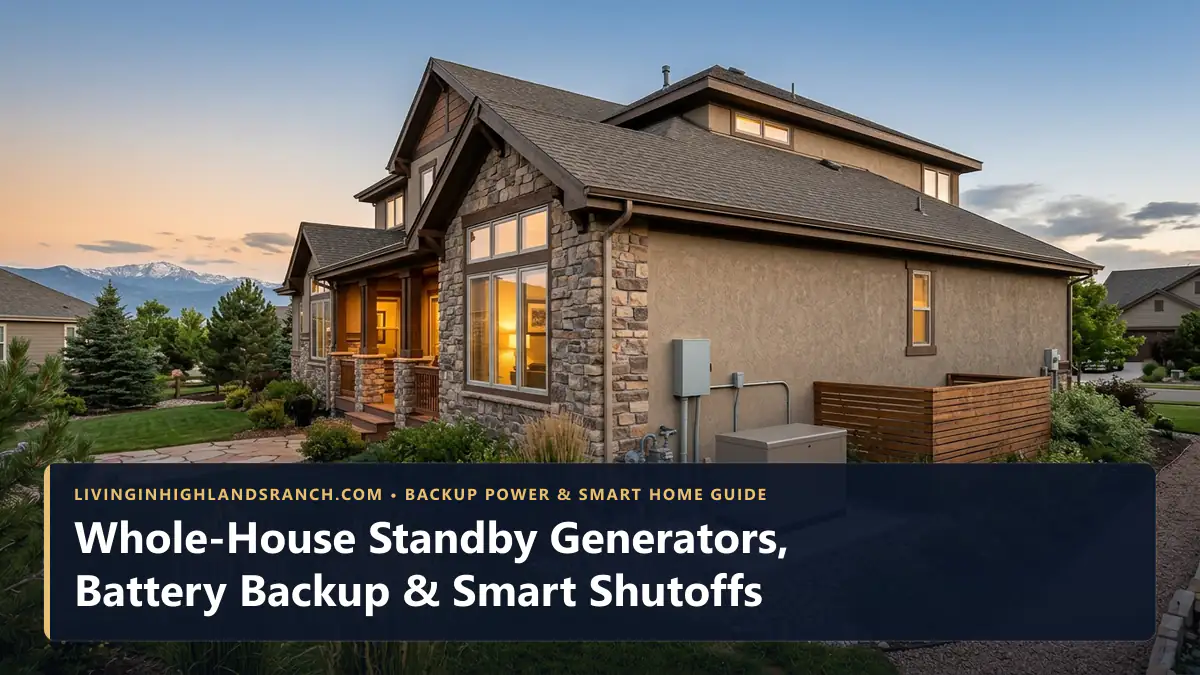
Whole-House Standby Generators, Battery Backup & Smart Shutoffs
Protecting a Highlands Ranch home from spring blizzard outages and winter pipe bursts comes down to matching backup hardware to your lot and utility setup. Across detached homes closing near ~$715,000 recently, thinner air near ~6,000 feet, tight side-yard clearances, and utility battery rebates completely reshape which upgrade makes sense.
Why Does Thin Air Above 5,900 Feet Shrink Standby Generator Output by ~21%?
Sea-level generator brochures mislead Front Range homeowners every winter. Because Highlands Ranch sits near 5,920 feet and climbs higher along our southern ridges, thinner oxygen cuts air-cooled engine output by ~21% before natural-gas BTU differences even enter the math.
High-altitude carburetion kits keep exhaust mixtures clean above 2,000 feet, yet they never restore lost horsepower. Pairing elevation-adjusted load calculations with our older-home electrical panel capacity guide highlights distinct starting points across three build eras in local sold-home and Douglas County property records:
- 1981–1999 Established Era (~$703,000 Median): Original 100-amp to 150-amp panels and 250 CFH gas meters in Northridge, Westridge, and Eastridge frequently need smart load-shedding relays or meter upsizing; ~7 in 10 sellers gave ~$11,100 toward closing credits.
- 2000–2014 Executive Era (~$720,000 Median): Dual-furnace 200-amp homes across Southridge, Firelight, and The Hearth offer modern breaker layouts, though ~6,100 to 6,800 sq ft lots tighten side-yard exhaust clearances.
- 2015–Present Newer Luxury (~$1.22M Median): Semi-custom homes in Backcountry and Central Park often combine 200-amp to 400-amp service with tall insulated garage bays ideal for wall-mounted battery stacks.
Should You Install a Natural-Gas Standby Generator or Xcel Battery Backup?
Buried underground electric feeders keep most Highlands Ranch outages far shorter than foothill blackouts, yet heavy spring blizzards still test furnaces, refrigerators, medical gear, and basement sumps. Choosing between a natural-gas engine outside and silent wall batteries in the garage comes down to runtime needs, side-yard width, and utility incentives.
While the federal residential clean-energy tax credit has expired for direct homeowner purchases, Xcel Energy’s Renewable Battery Connect pays up to $5,000 upfront. Stacking that utility rebate with Colorado’s 10% state energy-storage credit keeps garage battery walls highly competitive—especially alongside owned rooftop solar arrays.
| Upgrade Option | Typical Installed Scope & Incentives | What It Means for Your Home |
|---|---|---|
| 22–26 kW Natural-Gas Standby Generator | ~$12,000–$18,000 installed; delivers ~15–19 kW continuous on natural gas near 6,000 feet. | Unlimited multi-day winter runtime off buried gas lines; needs HRCA screening, 5-foot window clearances, and oil service. |
| Whole-Home Battery Wall (13.5–27 kWh) | ~$13,500–$24,000 before Xcel’s $250/kW AC rebate (up to $5,000) and 10% CO Form DR 1307 credit. | Silent indoor garage mount with instant millisecond switchover and zero side-yard exhaust rules; backs up key loads 12–36+ hours. |
| Manual Breaker Interlock + Portable Unit | ~$1,800–$3,200 total with a permitted panel interlock kit, exterior 30A/50A inlet, and dual-fuel inverter generator. | Budget backup for furnace blowers, refrigerators, and sumps; requires manual setup 20+ feet from doors and garages. |
| Inline Smart Water-Main Shutoff Valve | ~$1,100–$2,000 plumber-installed downstream of the main shutoff ball valve and 50–75 psi PRV. | Runs daily micro-leak pressure checks, closes the water main automatically on bursts, and often earns 5%–10% insurer credits. |
| 12V Battery-Backed Basement Sump System | ~$900–$1,600 installed beside your primary AC submersible pump beneath a sealed radon sump dome. | Protects finished lower levels when heavy April or May snowmelt coincides with brief neighborhood power flickers. |
+ More Data (Exact 90-day build-era $/SqFt cohorts, 2026 Xcel & DR 1307 schedules & derating math)
- Federal IRC Section 25D residential clean-energy credits expired December 31, 2025 for direct homeowner purchases.
- Colorado Form DR 1307 provides a 10% Innovative Energy Storage state income tax credit (or point-of-sale seller assignment) through December 31, 2029 alongside Colorado’s 2.9% state renewable-storage sales-tax exemption and Xcel Energy’s Renewable Battery Connect ($250/kW AC continuous discharge up to $5,000 upfront plus $100/year for 5 years).
- Non-HRCA (6 of 6 sold at a $668,091 median; $344 $/Above-Grade SqFt, $258 $/Finished SqFt, and $237 $/Total Structure SqFt across 536 parcels).
What HRCA Screening Rules and Douglas County Permits Govern Generators?
On a median ~6,800-square-foot Highlands Ranch lot, side-yard geometry eliminates many generator spots before an electrician ever opens the main panel. Both NFPA 37 fire standards and manufacturer listings typically require 5 feet of clearance from operable windows, doors, dryer vents, and concentric furnace flues so carbon monoxide never enters living space:
- HRCA Architectural & Decibel Submittal: Submit a dimensioned site plan, wide-angle yard photos, coordinated cedar or evergreen screening, and manufacturer decibel sheets (~57–67 dBA) under HRCA Residential Improvement Guidelines and Section 2.93 noise rules prior to installation.
- Douglas County 2023 NEC Transfer Switch Permit: Unincorporated Highlands Ranch installs require a Douglas County Building Division electrical permit for a UL-listed Automatic Transfer Switch and exterior disconnect so backup power never backfeeds utility linemen.
- Fuel-Gas Load & Xcel Meter Capacity: Running a 24 kW generator (~250,000+ BTU/hr) while winter furnaces and water heaters fire often starves a standard 250 CFH gas meter, requiring Douglas County fuel-gas pressure inspection and an Xcel meter upgrade.
- UL 9540 Garage Battery Spacing & Detection: Indoor wall-mounted lithium-iron-phosphate batteries skip exterior HRCA screening yet still require Douglas County electrical permits, interconnected garage heat alarms, and vehicle-impact protection where applicable.
How Do Smart Water-Main Shutoffs Pair With EyeOnWater and Sump Backups?
Across Colorado winters, split washing-machine hoses, aging supply pipes, and failed water-heater tanks ruin far more finished basements than grid outages. While Centennial Water’s free EyeOnWater portal flags hourly street-meter spikes, only an inline smart valve installed downstream of a healthy 50 to 75 psi pressure-reducing valve and expansion tank can shut your house main off within seconds.
As a residential builder, home rehab expert, and engineer, I share general construction perspective rather than performing licensed electrical, plumbing, or home inspections—pairing inline leak valves with our sump pump and perimeter drain guide. Also note conversationally that Colorado real estate fees are not set by law, are individually negotiable outside the MLS, and REcolorado MLS prohibits displaying broker compensation in any MLS field:
- Ultrasonic Main Valve + Wireless Leak Pucks: Plumber-installed valves such as Moen Flo or Phyn Plus run overnight micro-leak pressure tests and link to wireless floor pucks beneath water heaters, upstairs laundry pans, and kitchen sinks.
- Mini UPS Battery on Wi-Fi & Valve Actuator: Plugging your fiber gateway, router, and motorized water valve into a ~$75 battery backup keeps smartphone alerts and automatic shutoff rules active during storm power blips.
- 5%–10% Carrier Water-Loss Discounts: Several Colorado property insurers discount annual non-weather water premiums when a licensed plumber installs an approved automatic shutoff device—confirm your carrier’s qualifying model list first.
- Resale Permit & App Handover Checks: When buying a home with an existing generator or battery wall, ask independent licensed electrical and mechanical specialists to verify finalized Douglas County permits, high-altitude mixer settings, and app transfer at closing.
Frequently Asked Questions
Can townhome or patio-home owners in Highlands Ranch install a standby generator or garage battery?
Does a whole-house standby generator or single home battery run central air conditioning in summer?
Will Xcel Energy drain my backup battery right before a Colorado blizzard under Renewable Battery Connect?

Highlands Ranch Realtor, residential builder, home rehab expert, and engineer who shares general construction knowledge, layout and remodeling ideas for basements, decks, landscaping, and kitchens, and helps clients know what questions to ask independent licensed inspectors.
Evaluating panel capacity, backup upgrades, or side-yard clearances before buying or selling in Highlands Ranch?
Read Saber’s Realtor, Builder & Engineer Bio or reach out directly for a personal advisory conversation.