
Highlands Ranch Market Insights
Sprinkler Winterization & Backflow Freeze Guide (Highlands Ranch)

Sprinkler Winterization & Backflow Freeze Guide (Highlands Ranch)
One overnight drop into the low 20s in October can split an exposed brass backflow preventer or crack a shallow valve manifold, sticking you with a ~$650 spring plumbing bill. Draining the basement copper riser before the first hard freeze, capping compressed-air blowouts at 50 PSI, and parking every exterior brass valve at a 45-degree angle keeps your irrigation system dry until May.
How Do You Shut the Basement Isolation Valve and Drain the Interior Bleed Cap Before the First Hard October Freeze?
At nearly 6,000 feet along the Colorado Front Range, October weather plays a predictable trick: sunny 70-degree afternoons lull homeowners into running turf zones right up until a fast cold front drops overnight lows to 21 degrees. Even if your professional blowout appointment is still ten days out, isolating and draining the exposed copper loop before that first four-hour hard freeze prevents 90% of expensive brass and copper splits.
Underground zone pipes buried 10 to 12 inches beneath warm October sod stay insulated from a single overnight frost, whereas the vertical copper riser exiting your rim joist sits completely exposed to freezing night air. Walk down to your basement utility room or crawlspace and run this four-step drain-down sequence right alongside our seasonal home maintenance checklist & calendar:
- Switch the Controller to Standby Mode (Skip Unplugging): Set your garage or basement sprinkler timer to Off or Rain Standby so a scheduled 4 a.m. cycle does not energize dry solenoids while keeping your saved zone run times intact.
- Close the Basement Isolation Valve (90-Degree Lever): Follow your main water line just past the meter to the dedicated sprinkler branch tee and turn the brass ball-valve lever perpendicular to the pipe, or turn older round gate-valve wheels clockwise by hand without forcing corroded stems.
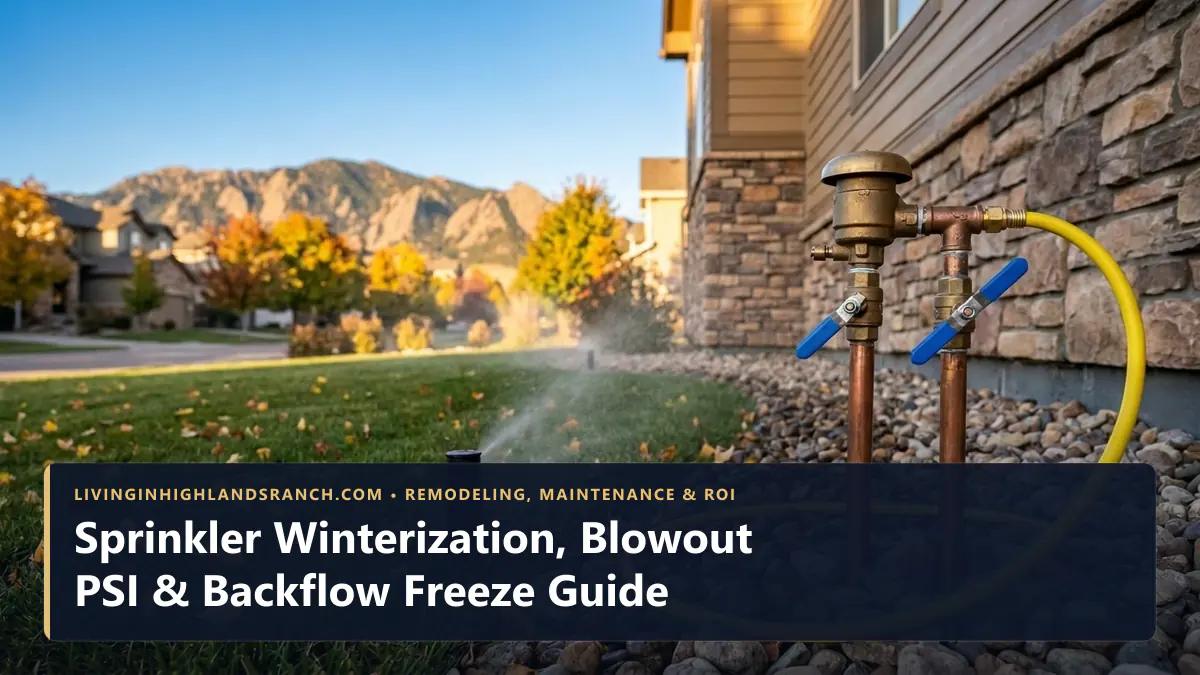
- Crack Exterior PVB Ports First (Break Vacuum Lock): Step outside to the brass backflow assembly and use a flathead screwdriver to turn both small slotted brass test cocks halfway open so air enters the top of the copper loop, just like lifting your finger off a drinking straw.
- Drain the Interior Brass Bleed Cap & Unscrew Hoses: Hold a quart cup beneath the tiny knurled brass bleed cap on the yard side of your basement shutoff valve, unscrew it slowly until the vertical riser drains dry, and disconnect every outdoor garden hose from frost-free spigots.
| System Zone or Component | Target Timing & Safe Limit | Freeze-Damage Repair Cost | What It Means for Your Home |
|---|---|---|---|
| Basement Shutoff & Bleed Cap | Early-to-mid Oct before 24°F night | ~$350–$900 split rim-joist copper | Empties the exposed copper riser even if your compressor blowout happens 1 to 2 weeks later. |
| Rigid Schedule 40 PVC Turf Zones | 45–50 PSI max · ≤2 min/zone | ~$275–$750 cracked valve manifold | Clears rotor and pop-up spray lines cleanly without shattering glued PVC tees or melting dry rotor gears. |
| Flexible Poly & Shrub Drip Zones | 25–30 PSI max · gentle pulses | ~$150–$400 blown poly fittings/drip | Protects 30-PSI drip pressure regulators, barbed couplings, and 1/4-inch tubing across mulch beds. |
| Brass PVB Backflow Assembly | 45° half-open handles & test cocks | ~$450–$950 replaced brass PVB | Releases water trapped behind hollow chrome valve balls that cracks housings when left fully open or shut. |
| Insulated Backflow Freeze Pouch | Brief 27–31°F Sept / May frosts | ~$25–$45 reusable insulated cover | Shields pressurized shoulder-season risers against light radiant frosts and UV bonnet wear, never deep winter cold. |
| Late-April Startup & EyeOnWater | 50–65 PSI house · 0.0 gal/hr idle | ~$180–$600+ hidden leak water bill | Slowly charging the loop stops PVB poppet shatter while EyeOnWater catches silent underground manifold leaks. |
+ More Data (See 3-era closed-sale cohorts, 3-benchmark $/SqFt, lot sizes & plumbing standards)
| Home Segment / Era | Median Price | Typical Days | Main & Upper $/SqFt | Finished $/SqFt | Full Footprint $/SqFt |
|---|---|---|---|---|---|
| Across 248 core detached resales closing at a $715,000 median in 27 days | $715,000 | 27 days | $349 | $286 | $244 |
| 1981–1999 detached homes | $482,500 | — | $355 | $286 | $250 |
- Across 32,143 core residential parcels, detached lots average 7,407 SqFt at 0.17 acres (6,795 SqFt median, typically running 5 to 9 residential irrigation zones across Westridge at 6,482 SqFt, Eastridge at 6,959 SqFt, Southridge at 7,780 SqFt, Northridge at 8,395 SqFt, and Backcountry at 10,388 SqFt), while 536 non-HRCA Province Center homes are isolated standalone at 7,322 SqFt average lot size and $668,091 closed median ($344 $/Above-Grade SqFt, $258 $/Finished SqFt, and $237 $/Total Structure SqFt).
- Compressed-air blowout thresholds align with Irrigation Association winterization guidelines (50 PSI ceiling on rigid Schedule 40 PVC mains; 30 PSI ceiling on SIDR polyethylene pipe and regulated micro-drip zones), ANSI/ASSE 1020 Pressure Vacuum Breaker assembly drainage clearances, and Centennial Water / Highlands Ranch Water cellular AMI meter telemetry via EyeOnWater.
What Is the Safe Compressed-Air Blowout PSI for Rigid PVC Mains Versus Flexible Poly and Drip Zones?
Every April I walk spring listings where the seller swears the sprinklers were professionally blown out in October, yet water bubbles straight up through the mulch beside the valve box. Nine times out of ten, whoever blew out the system confused airflow volume with raw air pressure and hooked an unregulated 100-PSI garage air line straight into plastic irrigation pipes.
Water carries weight, so moving water uphill out of buried pipe bellies requires steady cubic-feet-per-minute airflow volume rather than violent pressure spikes. Because compressed air flows much faster than water and creates zero cooling lubrication inside plastic gear heads, stick strictly to these four pressure and timing limits:
- 45 to 50 PSI Max on Rigid PVC Turf Mains: Lock an inline air pressure regulator between 45 and 50 PSI before opening air into rigid white Schedule 40 PVC main lines and pop-up turf zones; slamming 80 to 120 PSI air into cold brittle PVC shatters 90-degree elbows and blows rubber wiper seals out of rotor heads.
- 25 to 30 PSI Max on Poly Laterals & Drip Beds: Many Front Range lawns use flexible black polyethylene lateral pipe alongside shrub and garden drip zones fitted with 30-PSI inline pressure regulators; dial air down to 25 to 30 PSI before running drip stations so barbed couplings do not pop apart and emitters stay seated.
- Open One Zone Valve Before Introducing Air: Always activate your furthest or highest zone at the controller before opening the compressor supply valve, and step smoothly from zone to zone so compressed air is never dead-headed against a closed plastic manifold or backflow float assembly.
- Two Short 60-to-90-Second Passes (Zero Dry Overheating): Compressed air gets hot fast and dry nylon gears inside rotary sprinkler heads melt if spun dry for five straight minutes; run each station for 60 to 90 seconds until solid spray turns to fine mist, cycle through the remaining zones, and run one brief second pass.
Why Must Brass PVB Backflow Ball Valves and Test Cocks Stay at a 45-Degree Angle All Winter?
Even after a textbook air blowout, one simple handle mistake ruins more ~$650 brass Pressure Vacuum Breaker assemblies than anything else in Douglas County: parking the exterior blue valve levers either completely shut at 90 degrees or completely open in line with the pipe. Inside every quarter-turn brass ball valve sits a hollow chrome sphere turning inside snug polymer seats.
When a ball valve sits either fully closed or fully open, a thin crescent chamber between the outside of the chrome ball and the outer cast-brass wall traps half a teaspoon of water that compressed air physically cannot reach. When January nights hit zero degrees, that tiny ring of ice expands by roughly 9% and splits a hairline fracture right down the brass casting:
- Set Both Blue Ball-Valve Handles at 45 Degrees: Once blowing is finished and the compressor hose comes off, turn both the lower inlet ball valve and upper outlet ball valve exactly halfway to a diagonal 45-degree angle so the trapped side cavity behind the ball vents freely into the open pipe bore.
- Leave Both Slotted Brass Test Cocks at 45 Degrees: Each tiny screwdriver-slotted test cock on the side of a Febco, Watts, or Wilkins backflow preventer is a miniature ball valve with the exact same hidden water pocket; leave both screwdriver slots angled diagonally at 45 degrees all winter.
- Insulated Pouches for Sudden September or May Frosts: An unheated insulated pouch creates zero heat during a three-day December deep freeze, so never skip draining for a cover; where a ~$35 insulated pouch shines is shielding a live riser during a brief 28-degree dip in late September or mid-May when grass still needs fall or spring watering (drain the copper loop if lows drop below 25 degrees for 4+ hours).
- UV Bonnet Protection Without Trapping Wasps: High-altitude winter sunlight turns clear plastic PVB float bonnets chalky and brittle over time; slipping a breathable insulated cover over your drained assembly in November blocks harsh UV rays while keeping mud-dauber wasps from packing open 45-degree test cocks with clay.
Across local sold-home and Douglas County property records, knowing what generation of irrigation hardware sits in the yard also helps buyers and sellers avoid surprise escrow holdbacks during fall and winter closings:
- 1981–1999 Established Neighborhoods (166 Closed · $702.5K Median): Original Northridge and Eastridge systems frequently pair aging brass basement gate valves (whose rubber washers seep slightly even when cranked shut!) with black poly laterals and weathered Febco 765 bonnets; if two drops per minute seep past an old basement gate valve all winter, ice builds an upward plug inside the exterior riser until it splits, making a crisp quarter-turn ball-valve upgrade (~$180–$320 via a licensed plumber) smart insurance in an era where ~71% of sellers paid credits averaging ~$11,100.
- 2000–2014 Executive Era (62 Closed · $720K Median): Larger Southridge and Westridge lots often step down walkout side-yard grades with two separate subterranean valve boxes and dedicated 30-PSI shrub drip loops; blow out lower walkout zones last so gravity drainage from upper turf lines does not refill the bottom manifold overnight.
- 2015+ Newer Homes, Townhomes & Province Center: Newer luxury builds ($1,224,975 closed median) commonly run Wi-Fi smart controllers, master valves, and multi-bed ColoradoScape drip hydrozones requiring gentle 25-to-30-PSI air passes; in attached townhome communities ($482,500 median) the HOA manages exterior turf blowouts, while standalone non-HRCA Province Center single-family homes ($668,091 median) maintain private basement shutoffs and backflow assemblies just like core detached lots.
How Do You Repressurize Safely in Spring and Check EyeOnWater for Hidden Underground Leaks?
More plastic backflow poppets shatter on the first warm Saturday in May than in October, simply because homeowners throw the basement ball valve wide open into an empty copper pipe. Water rushing at 65 PSI into an air-filled riser slams the plastic PVB float assembly into its top cap with violent hydraulic water hammer before cracking downstream PVC tees.
Before turning your system back on in late April or mid-May, confirm your indoor pressure-reducing valve holds house water near 50 to 65 PSI using our water heaters, thermal expansion tanks & PRV guide, then pair a slow fill with real-time meter monitoring from our Highlands Ranch Water & EyeOnWater leak alert guide. Everything shared here offers general construction knowledge, plumbing maintenance perspective, and local sold-home math from my background as a Residential Builder and Engineer rather than a licensed plumbing or irrigation inspection—always hire a licensed plumber, certified backflow technician, or independent home inspector to test and service your specific equipment (and remember Colorado real estate fees are not set by law, remain 100% individually negotiable outside the MLS, and cannot be displayed or offered in REcolorado MLS):
- Prep Exterior Valves First (Downstream Shut, Upstream Open): Tighten the basement brass bleed cap snug by hand, then outside turn both slotted brass test cocks perpendicular (closed), turn the upper downstream ball valve fully closed so air does not race into dry yard mains yet, and set the lower upstream handle parallel (open).
- Crack the Basement Valve 20% to Seat the PVB Poppet: Open the basement isolation lever only one-fifth of the way until you hear water gently filling the copper riser; step outside to confirm the plastic PVB air-inlet poppet snaps upward and stops spitting after two seconds, open the basement valve all the way, and then slowly crack the upper downstream PVB valve over 30 seconds to fill the main line.
- Audit EyeOnWater for 0.0 Gal/Hr Idle Mainline Flow: With the main line pressurized and every sprinkler zone still Off, check your cellular smart meter inside the free EyeOnWater app over two quiet daytime hours; even a hairline winter split in a buried manifold or weeping diaphragm leaks 15 to 40 gallons per hour straight into bentonite clay near your foundation without showing a surface puddle.
- Walk Every Turf & Drip Zone in Daylight + Set Leak Alerts: Run each station manually for two minutes to spot snow-shovel-sheared driveway heads, clogged rotary nozzles, or winter rabbit chews in 1/4-inch drip lines, and keep a 1-to-2-gallon-per-hour continuous-flow alert active in EyeOnWater all summer.
Frequently Asked Questions
Can you winterize a residential sprinkler system yourself with a small pancake garage air compressor?
Should you unplug your Wi-Fi or digital sprinkler controller over winter or keep it powered in Standby Mode?
Do underground T-handle curb-stop drains or automatic gravel drain valves replace a compressed-air blowout in Colorado clay?

Realtor, Residential Builder, Home Rehab Expert, and Engineer sharing general construction knowledge, landscaping and mechanical system perspectives, local sold-home math, and practical questions to ask licensed plumbers, irrigation technicians, and home inspectors.